

The best sediment filter for well water depends on your sediment load, not on brand loyalty. A spin-down pre-filter with a reusable stainless mesh screen handles heavy sand and grit with no consumables, while a 4.5 inch x 10 inch or 20 inch x 4.5 inch pleated or melt-blown cartridge catches fine silt, clay and rust before it reaches your softener. Most homes end up running both, in that order.
We spent weeks going through the specs, the flow ratings and thousands of owner reviews on ten of the best sediment filters for well water on the market now, then matched each one to the type of sediment it actually handles well. The list below covers both mechanisms, both housing sizes, and the micron bands that matter at each stage of the chain.
One thing worth saying up front: no sediment filter makes well water safe to drink, and none of them touch hardness, nitrate or bacteria. They protect your plumbing, your faucets, your water heater and your softener resin. If you want the full picture of what a well needs beyond sediment control, start with our well water filter picks and our whole house filtration guide.
Table of Contents
- Top 3 Picks: Best Sediment Filters for Well Water (October 2026)
- All 10 Sediment Filters at a Glance
- What Sediment Do You Actually Have?
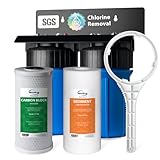
- 1. iSpring WGB21B 2-Stage System – Best Overall
- 2. Membrane Solutions 5 Micron String Wound 6-Pack – Best for High-Load Wells
- 3. iSpring WSP-50 Spin-Down Filter – Best Spin-Down
- 4. PUREPLUS 5 Micron 10 x 4.5 Inch 2-Pack – Budget Pick
- 5. Aquaboon 5 Micron 20 x 4.5 Inch Cartridge – Best 20 Inch Value
- 6. iSpring 5 Micron 20 x 4.5 Inch 2-Pack – Best High-Capacity
- 7. A. O. Smith AO-WH-PREV – Best Compact Install
- 8. Pentek DGD-5005 Big Blue Cartridge – Best for Softener Protection
- 9. Waterdrop WHF21-FG 2-Stage System – Best for Iron and Manganese
- 10. Aquaboon 20 x 4.5 Inch Housing – Best Built-In Pressure Gauge
- How to Choose the Right Micron Rating
- Spin-Down vs. Cartridge: Which One Do You Live With?
- What Well Owners Report on Forums
- What a Sediment Filter Cannot Remove
- Frequently Asked Questions
- What is the best in-line sediment filter for well water?
- What type of sediment filter is best for well water?
- What is the best spin-down filter for well water?
- What is the difference between a sediment filter and a spin-down filter for well water?
- How many microns should a whole house sediment filter be?
- Is a spin-down sediment filter worth it?
- Conclusion: Which Sediment Filter Should You Buy?
Top 3 Picks: Best Sediment Filters for Well Water (October 2026)
iSpring WGB21B 2-Stage System
- 5-micron sediment plus CTO carbon block
- 1-inch ports
- 15 gpm rated

PUREPLUS 5 Micron 10 x 4.5…
- String-wound polypropylene
- 30000 gallon rating
- universal Big Blue fit

iSpring WSP-50 Spin-Down…
- 50-micron stainless mesh
- reusable and flushable
- 1-inch MNPT ports
All 10 Sediment Filters at a Glance
| Product | Specs | Action |
|---|---|---|
| iSpring WGB21B 2-Stage Whole House System |
|
Check Latest Price |
 Membrane Solutions 5 Micron String Wound 6-Pack Membrane Solutions 5 Micron String Wound 6-Pack |
|
Check Latest Price |
| iSpring WSP-50 Spin-Down Sediment Filter |
|
Check Latest Price |
| PUREPLUS 5 Micron 10 x 4.5 Inch 2-Pack |
|
Check Latest Price |
 Aquaboon 5 Micron 20 x 4.5 Inch Cartridge Aquaboon 5 Micron 20 x 4.5 Inch Cartridge |
|
Check Latest Price |
 iSpring 5 Micron 20 x 4.5 Inch 2-Pack iSpring 5 Micron 20 x 4.5 Inch 2-Pack |
|
Check Latest Price |
 A. O. Smith AO-WH-PREV Valve-in-Head Filter A. O. Smith AO-WH-PREV Valve-in-Head Filter |
|
Check Latest Price |
 Pentek DGD-5005 Big Blue Cartridge Pentek DGD-5005 Big Blue Cartridge |
|
Check Latest Price |
 Waterdrop WHF21-FG 2-Stage System Waterdrop WHF21-FG 2-Stage System |
|
Check Latest Price |
 Aquaboon 20 x 4.5 Inch Housing with Gauge Aquaboon 20 x 4.5 Inch Housing with Gauge |
|
Check Latest Price |
What Sediment Do You Actually Have?
Before any filter makes sense, you have to know what it is catching. The type of particle changes the micron band, the mechanism and how often you will be doing maintenance.
Clear water iron looks like nothing at the tap and turns orange a few minutes later in a glass. It is dissolved until it oxidizes, which is why a plain sediment cartridge can go from white to rust brown in a single service cycle.
Red water is the same iron, already oxidized. It stains tubs, laundry and toilets, and it will load a 5 micron cartridge quickly on a high-iron well.
Black or dark brown flakes are usually manganese rather than iron. Manganese is not captured by a standard sediment stage, which is where a dedicated stage such as the Waterdrop system below earns its place.
Coarse sand and grit feels gritty in the tub and shows up in faucet aerators. This is a spin-down job, and running a fine cartridge first just burns through it.
Fine red clay and silt gives the water a slightly milky look that never quite settles. Clay particles are small and stay suspended, so they need depth-loading media rather than a surface screen.
A quick diagnostic: fill a clear glass from the cold tap and let it sit for an hour. A settled layer of grit means sand. Water that clouds and stays cloudy means silt or clay. Water that is clear then stains means dissolved iron.
1. iSpring WGB21B 2-Stage System – Best Overall
iSpring WGB21B 2-Stage Whole House Water Filtration System, 50000 Gallons
Two-stage
5-micron PP sediment then CTO carbon
1-inch ports
15 gpm max flow
26 by 19 by 11 inch
Pros
- Pairs a 5-micron sediment cartridge with a CTO carbon block for chlorine taste and odor
- Thick housings owners describe as substantial
- 1-inch ports hold 15 gpm with low pressure loss
- US-based support that replaced leaking parts
Cons
- NPT fittings need generous Teflon tape to seal
- Housing can crack if a plumber overtightens the threads
- Occasional pinhole leaks at the canister connections
This is the pick we keep coming back to because it solves two problems in one footprint. The first stage is a 5-micron polypropylene sediment cartridge, the second is a CTO carbon block tested to NSF/ANSI 42, so you get mechanical filtration and chlorine, taste and odor reduction from a single bracket-mounted assembly.
Measured at 26 by 19 by 11 inches, it is not a slim unit, but the 1-inch inlet and outlet and the 15 gpm maximum flow rating mean it will not choke a household running two showers and a dishwasher at once. The reversible housing layout also lets you match the direction of your existing plumbing, which saves rework in a tight utility room.
The thing that stood out most in the reviews was not filtration performance, it was support. Owners describe iSpring replacing manifolds, O-rings and complete filters at no charge for leaks and cracks, sometimes well past the warranty period. That is a real advantage on a unit whose biggest practical risk is thread sealing.
Capacity is listed at 50,000 gallons with a 12-month filter life cycle, which works out to roughly a year for a family of four. It retains beneficial minerals and does not reduce TDS, so it will not strip the hardness out of your water the way an RO membrane would.
What to check before you buy
Both housings are threaded NPT, which means the fittings need real sealing. Reviewers consistently report wrapping the tape many times, and a few mention using pipe dope alongside it. Budget five extra minutes per connection rather than chasing a weep mark on the floor later.
Confirm you have clear vertical space for a unit this tall. The footprint is 26 inches long, and the wrench needs room to swing on the cap, so measure the wall before the box arrives.
Who should skip it
Skip this system if you have a very heavy sand load and no plan to run a coarse pre-filter ahead of it. Owners on high-grit wells who installed it as the only sediment stage report short cartridge life, and the fix is upstream, not in this unit.
Also skip it if your softener or iron filter is already doing a good job and you only need to strip sand at the point of entry. For that job a single spin-down is simpler and lasts longer between service visits.
2. Membrane Solutions 5 Micron String Wound 6-Pack – Best for High-Load Wells
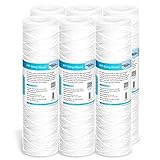
Membrane Solutions 5 Micron 10″x2.5″ String Wound Whole House Water Filter Replacement Cartridge Universal Sediment Filters for Well Water – 6 Pack
String-wound depth filtration
5-micron nominal
10 x 2.5 inch format
6 cartridges
15,000 to 20,000 gallon rated life
Pros
- Six cartridges in one pack means a long replacement interval on hand
- Seals well without reducing flow or pressure
- Reliable on rural high-iron well water as a first stage
- Consistent fit across standard 10 inch housings
Cons
- Change interval varies with sediment load
- Certification covers material requirements only
String-wound media is the choice for wells that load up fast. Rather than trapping particles on the surface like a melt-blown element, the graded honeycomb structure catches them throughout the thickness of the winding, which is why this format holds more dirt per cartridge than a comparable spun element.
The manufacturer claims four times the dirt-holding capacity and double the flow of a polypropylene sediment filter, and reviewers on rural wells broadly agree with the direction of that claim even if they hedge on the exact multiple. Rated life is 15,000 to 20,000 gallons with a recommended change at least every six months.
Getting six at once matters more than it sounds. On a well that needs monthly changes, a single cartridge at a time means you will eventually run out on a Sunday, and replacement cartridges are not always as easy to find at short notice as people assume.
The one detail that catches people out is size. This is the smaller 10 by 2.5 inch format, not the 10 by 4.5 inch Big Blue size. Measure the diameter of your housing cap before you order, because the two look similar and do not interchange.
What to check before you buy
Confirm your housing is 10 by 2.5 inch. The included fit list covers common undersink and inline purifier housings such as GE GNSV70R and Whirlpool WHKF-GD05, and the element is made of 100 percent food-grade polypropylene that is lead and BPA free.
Check the certification wording before you rely on it. This cartridge is certified to NSF/ANSI Standard 42 for material requirements, which is a different claim from certified contaminant reduction. For sediment removal on a private well that distinction rarely matters, but it matters if you are writing this into a treatment plan.
Who should skip it
Skip it if your problem is coarse sand. A string-wound 5 micron element is the wrong tool for grit, and it will load up long before it captures anything large. Put a spin-down in front of this instead.
Skip it if your housing is 4.5 inch diameter. You would need the larger Big Blue format, and buying the wrong diameter is the single most common wasted order in this category.
3. iSpring WSP-50 Spin-Down Filter – Best Spin-Down
iSpring WSP-50 Spin Down Sediment Filter, Whole House Prefilter, 50 Micron
50-micron stainless steel mesh
Lead-free brass body
Clear housing
1-inch MNPT and 3/4-inch FNPT both ends
Hose barb flush valve
Pros
- Reusable stainless mesh you flush instead of discarding
- Easy to service and shows what it is catching
- Noticeably extends the life of fine filters behind it
- Bottom valve doubles as a system bleed-down point
Cons
- 50 micron is too fine for silty or heavy-sand wells
- O-rings wear out and are not sold separately
- Short body means more frequent cleanouts than a jumbo model
This is the filter we recommend in front of almost everything else on this list. Water enters under pressure, the heavier particles are thrown outward against the housing wall by centrifugal force, and the clear bowl below collects them until you open the flush valve and let them go. Nothing is consumed, so the running cost is zero.
The screen itself is 50-micron stainless steel mesh in a machined lead-free brass body, rated to last one to two years. Both ends are dual-threaded with 1-inch MNPT and 3/4-inch FNPT, which makes it unusually easy to adapt to whatever pipe size you already have.
The 50-micron rating is where the debate is. Owners on relatively clean wells treat this as a durable first stage. Owners on silty or iron-heavy wells report it clogging within days, then switch to a coarser 100 or 200 micron screen, which iSpring has been known to provide. If your water is visibly gritty, start coarser than 50.
Rated for 40 to 100 degrees Fahrenheit and 15 to 115 psi, indoor use only. The clear housing is the practical win, because you can see the loading level and flush on a schedule instead of guessing.
What to check before you buy
Decide your drain line before ordering. A spin-down needs somewhere to discharge, and a hose barb flush valve with a nearby floor drain or a route to outside is the part of the install that decides whether this is a one-afternoon job or a plumber visit.
Check the height. At 9 inches tall and 3.5 inches across, the body is compact, which is good for tight spaces and also means a smaller sump that fills faster on heavy sediment.
Who should skip it
Skip the 50-micron version if you have fine silt or clay. Those particles slip past a mesh screen and will need a cartridge stage behind it. Use this as a coarse guard, not as your only filter.
Skip any spin-down if you will not flush it. A neglected spin-down becomes a pressure restriction, and on some installations that shows up as a shower that feels like a drizzle. If you know you will forget, an auto-flush module is worth considering instead.
4. PUREPLUS 5 Micron 10 x 4.5 Inch 2-Pack – Budget Pick
PUREPLUS 5 Micron 10 x 4.5 Whole House Water Filter for Well Water 2 Pack
String-wound polypropylene
5-micron nominal
10 x 4.5 inch Big Blue format
2.5 GPM rated flow
30,000 gallon capacity
Pros
- Highest average rating in this roundup with 86 percent five-star reviews
- Effective on fine sediment and iron particles that clog appliance screens
- Holds flow pressure steady through its service life
- Two-pack means a spare is always on hand
Cons
- Cartridge can sit off-centre as you tighten the cap
- Winding is coarser than premium-brand cartridges
- On very dirty wells it can clog in about a month
This cartridge carries the highest average rating of the ten at 4.8, and the review distribution backs it up with 86 percent five-star. String-wound polypropylene is graded dense on the inside and sparse on the outside, so coarse particles hit the outer layers and fine ones are caught deeper in the element.
Capacity is listed at up to 30,000 gallons depending on water quality, with a 2.5 GPM rated flow. That flow figure is the honest part of the spec sheet: it describes a cartridge in a modest housing, not a system that will serve three bathrooms at full blast.
Owners on high-sediment wells single this out as the element that actually clears dirty water before the softener, and several report no measurable pressure drop as it ages. Iron-heavy users note the element turning brown and changing it roughly every four months, which they consider the correct outcome since the iron ends up in the cartridge rather than in the faucet aerators.
Fit is broad. It is compatible with American Plumber, Culligan, GE, Pentek, Whirlpool and Aqua-Pure 10 by 4.5 inch housings, which covers most of the generic Big Blue housings you will find in the wild.
What to check before you buy
Note the flow rate against your household demand. At 2.5 GPM this is a polishing stage behind a spin-down, not a standalone whole house filter. If you need more than that through a single cartridge, the 20 inch format is the one to size up to.
The material is food grade and BPA free and meets EC1935-2004 and WaterMark requirements, and the production is documented under ISO 9001 and 14000 with pressure and water hammer testing. That is a more detailed certification trail than most cartridges in its class offer.
Who should skip it
Skip it if you are running it as your first and only stage on a heavy well. Without a coarse pre-filter upstream, a 5 micron element is the wrong place to absorb sand and grit, and the roughly one-month interval on very dirty water is exactly what reviewers report.
Skip it if you are fussy about winding consistency. Some owners note the winding is coarser than premium-brand cartridges, and a minority report the element threading in slightly off-centre when the cap is tightened hard.
5. Aquaboon 5 Micron 20 x 4.5 Inch Cartridge – Best 20 Inch Value
Aquaboon 5 Micron 20 x 4.5 Sediment Water Filter Replacement Cartridge
Melt-blown polypropylene
5-micron
20 x 4.5 inch Big Blue size
4 to 6 month service life
2-pack
Pros
- Graded pore structure maintains steady flow with minimal pressure loss
- Chemical and corrosion resistant for whole house use
- Long replacement interval of 4 to 6 months
- Drops into standard 20 inch Big Blue housings
Cons
- Only fits 20 x 4.5 inch housings
- Heavier element than 10 inch cartridges
- Melt-blown media needs a free flush after installation
This is the one to buy if you already run a 20 inch Big Blue housing. It is 100 percent melt-blown polypropylene with a layered design where the outer layers catch larger debris and the inner layers polish, which is the standard dual-gradient approach and the reason it holds steady flow as it loads.
At 4.5 inches in diameter by 20 inches tall it simply drops into a standard 20 inch housing without modification. Buyers repeatedly make the point that they had to buy the 20 by 4.5 inch size specifically, because this is the larger Big Blue format and will not fit a 10 inch housing.
The 4 to 6 month service life is the headline for owners. That is longer than the monthly swaps heavy wells tend to force, and it is a direct consequence of the larger media volume inside a 20 inch sump compared with a 10 inch one.
It is also compatible with several 20 inch housings named in the spec sheet, including 3M AP802B, 3M AP802T, 3M AP810-2, AcalaQuell Smart and SimPure DB20P. Reviewers report clear improvement in water clarity and less debris reaching faucets.
What to check before you buy
Measure the housing first. This element is 20 inches long. If your housing is the 10 by 4.5 inch Big Blue, the physical length alone will tell you it does not fit, and that mistake is easy to make because the diameter is identical.
Flush the new element before you install it. Melt-blown media arrives with trapped air and manufacturing residue, and a quick flush in a bucket or a cold line gets both out before the water reaches your plumbing.
Who should skip it
Skip it if you are running a 10 inch housing or a slim 10 by 2.5 inch inline filter. The dimensions simply do not work, and ordering the wrong length is the most common wasted purchase in this category.
Skip it if you have not addressed upstream sediment. A 5 micron element can only be the second stage. On a well that kicks sand when the pump starts, put a spin-down in front of it.
6. iSpring 5 Micron 20 x 4.5 Inch 2-Pack – Best High-Capacity
iSpring 5-Micron 20″ x 4.5″ Whole House Water Filter Sediment Removal
Melt-blown FP25B
5-micron
20 x 4.5 inch
100,000 gallon rating
15 GPM flow
2-pack
Pros
- Handles high-iron well water and removes metallic odor and staining
- 100000 gallon rating with minimal flow restriction
- Fits standard 20 inch housings from other brands
- Individually wrapped cartridges stay fresh in storage
Cons
- Port sealing on the surrounding manifold is where leaks occur
- Housing removal during changes is awkward when full of water
On paper the capacity figure here is the largest in the roundup at 100,000 gallons, with a 15 GPM rated flow and a one-year filter life cycle. Owners on iron-heavy wells say these cartridges finally eliminated the metallic smell and laundry staining they had been living with, and the visible contrast in the spent element is its own proof of capture.
The cartridge is the FP25B series, third-party tested to NSF/ANSI standards, and it fits standard 20 by 4.5 inch housings including the iSpring WGB32B and WHO32B series. Two cartridges come in the pack, individually wrapped for freshness, which matters if you are storing spares for a year.
The important caveat is that the 100,000 gallon number is a clean-water figure. On a well with a real sediment load the interval is governed by pressure drop, not by gallons, and reviewers on high-iron wells change on the schedule the water tells them rather than the calendar.
The 15 GPM rating also assumes a 1-inch ported housing. If your housing is plumbed with 3/4-inch lines, your real ceiling is set by the pipe, not by the cartridge.
What to check before you buy
Check the manifold connections on your existing housing, not the cartridge. The most common complaints about this product are not about the element at all. They are about plastic manifold ports being hard to seal, and the repeated advice is many wraps of Teflon tape plus a pipe sealant.
Plan for the change procedure. Removing a 20 inch housing when it is full of water is awkward on its own, so a spare container and a place to set the drained housing make the ten-minute job a five-minute job.
Who should skip it
Skip it if you have no 20 inch housing and no plan to add one. It is a cartridge, not a system, and it will not do anything in a plumbed 10 inch setup.
Skip it if your sediment is coarse sand. This is a polishing element, and coarse grit belongs in a spin-down ahead of it, not in a cartridge rated for 5 micron nominal capture.
7. A. O. Smith AO-WH-PREV – Best Compact Install
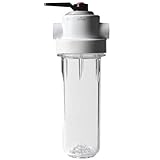
A. O. Smith Whole House Sediment Filter | Valve-in-Head | AO-WH-PREV
Valve-in-head design
3/4 inch ports
6 gpm max flow
Clear housing
15 by 6 by 5 inch
24,000 gallon capacity
Pros
- Low-profile housing that fits tight utility spaces
- Runs with no power supply during outages
- Metal female thread connectors rather than all-plastic threads
- Integrates easily ahead of a carbon stage or softener
Cons
- Clear plastic housing can crack at the threads and leak
- Smaller port size reduces flow versus 1-inch units
- Weak mounting bracket out of the box
This is the most compact complete unit in the roundup at 15 by 6 by 5 inches, and the valve-in-head design is the reason. Shut-off, bypass and pressure release are built into the head rather than added with separate valves, so the footprint stays tight and a cartridge change is genuinely quick.
It is certified to NSF/ANSI Standard 42 for particulate reduction, operates passively with no electricity, and includes the housing, a first sediment cartridge and a housing wrench. Rated at 6 gpm through 3/4 inch connections, with a 24,000 gallon capacity and a six-month filter life cycle.
This is the lowest-rated pick here at 4.3, and the reviews explain why without ambiguity. Filtration performance is generally praised. The sticking point is housing durability, with multiple owners reporting the clear plastic cracking at the threaded collar within a year and then leaking, which forces replacement of the whole unit.
What people like is the low profile, the metal connectors and the fact that it keeps working through a power outage. The clear housing is a genuine convenience for judging cartridge life by eye.
What to check before you buy
Look at the wall you are mounting to. Reviews describe the included bracket as weak out of the box, and a cracked housing that then leaks is an expensive lesson to learn twice. If the surface is drywall, reinforce the anchors rather than trusting the supplied hardware alone.
Work out whether 6 gpm is enough. That is a fine ceiling for a small home with one or two fixtures running at once, and a real restriction in a house with three bathrooms.
Who should skip it
Skip it if you have high flow demands. The 3/4 inch ports are the limiting factor, and owners upgrading to 1-inch systems report noticeably better flow on high-demand homes.
Skip it if you have a track record of leaking threaded housings. Several reviewers had to replace the unit after a thread-side crack, which is a recurring rather than isolated complaint.
8. Pentek DGD-5005 Big Blue Cartridge – Best for Softener Protection
Pentair Pentek DGD-5005 Big Blue Whole House Sediment Filter
Dual-gradient density
5-micron
10 x 4.5 inch
Under 1 psi drop at 10 gpm
Six-month interval
2-pack
Pros
- Dual-gradient density gives more dirt-holding capacity than similar cartridges
- Very low pressure drop
- under 1 psi at 10 gpm
- Fits every 10 inch Big Blue and other heavy-duty housing
- Imparts no taste odor or colour to the water
Cons
- Spun rather than string wound
- so some buyers prefer wound media
- Must be sized correctly or it will not seat
This is the default pre-filter cartridge many owners choose, and the reason is the dual-gradient density construction with up to three times the dirt-holding capacity of a conventional element and 233 percent greater effective filter depth. In practice that means fewer changes between services on a moderately dirty well.
The pressure drop figure is the one that makes it a good softener guard: under 1 psi at 10 GPM. Softener resin is expensive to replace when it is fouled with sediment, and a cartridge that will not choke the flow at that rate is doing its job quietly.
Long-term buyers describe it as the element they install ahead of softeners and RO systems, replacing every four to six months based on what accumulates in the clear housing rather than on a calendar. Reviewers confirm it seats in Big Blue housings without leaks.
It is independently tested and certified to NSF/ANSI Standard 42 for material requirements, and it is available in packs of one, two and eight, so the bulk pricing improves on larger households.
What to check before you buy
Confirm the housing is 10 by 4.5 inch. This is the standard Big Blue footprint, and a mismatch means it simply will not seat. A quick measurement of the cap diameter is enough.
Decide how you will judge service life. The recurring advice in the reviews is to change on pressure and flow rather than on a date, and a housing you can see through makes that judgement much easier to make correctly.
Who should skip it
Skip it if you specifically want string-wound media. A minority of buyers prefer wound construction and consider the spun format inferior for their water, so this is a preference rather than a performance gap.
Skip it as a first stage on a sand-heavy well. No 5 micron cartridge is the right place to absorb grit, and adding a spin-down ahead of this one is cheap insurance against short cartridge life.
9. Waterdrop WHF21-FG 2-Stage System – Best for Iron and Manganese
Waterdrop WHF21-FG 2-Stage Whole House Water Filter System, NSF/ANSI 372
Two-stage 10 x 4.5 inch system
Iron and manganese stage plus GAC carbon
1-inch NPT ports
15 gpm
50,000 gallons per stage
Pros
- Targets iron and manganese specifically
- which suits well water
- Also reduces heavy metals including lead mercury cadmium chromium and copper
- Reinforced brass threads and dual O-rings resist leaks
- Pre-installed filters and bracket make setup straightforward
Cons
- Mixed feedback at 4.4 average rating
- Installation needs careful Teflon tape wrapping to avoid leaking
This is the only unit here with published reduction figures for the two contaminants a plain sediment cartridge cannot handle. Third-party testing gives 96.4 percent iron reduction, 98.2 percent manganese reduction and 95.63 percent chlorine reduction, which is the whole reason this system exists in the roundup.
The second stage is coconut shell granular activated carbon, so you get taste and odor improvement at the same time. Both cartridges meet NSF/ANSI 372 lead-free standards, and the whole assembly runs on 1-inch NPT ports at up to 15 gpm.
Well water users report metallic taste and staining improving noticeably after installation. The 6-month, 50,000-gallon replacement interval per stage and the 15 gpm flow figure come up repeatedly as the practical details that make it livable in a real household.
The weak spot is installation technique rather than filtration. Leak-prone threaded connections and occasional housing or bracket issues are the most common negatives, which is exactly why the design uses reinforced brass threads and dual high-sealing O-rings, and why the same advice recurs: wrap generously and use a sealant.
What to check before you buy
Be clear about what you are solving. If your problem is only sand, a complete two-stage carbon system is a heavier answer than the situation needs, and a single spin-down covers the same problem. If you have confirmed iron or manganese in the water, the equation changes completely.
Check your pressure situation too. Any iron or manganese stage downstream of a well pump still runs on the pump’s service flow, and if you plan to add a backwashing iron filter later, that design needs a flow rate a small residential well pump may not deliver.
Who should skip it
Skip it if you have tested and confirmed no iron or manganese. You would be paying for capability your water does not require, and the carbon stage alone could be a simpler addition.
Skip it if you are not comfortable sealing NPT threads. The 4.4 average rating reflects mixed feedback, and most of that feedback is about leaks at the connections rather than about filtration.
10. Aquaboon 20 x 4.5 Inch Housing – Best Built-In Pressure Gauge
Aquaboon 20″ x 4.5″ Whole House Well Water Filter System with Pressure Release (1″ Port) | Certified | Compatible with Pentek 150233, 150235, Geekpure BB- 20B
20 x 4.5 inch Big Blue style housing
1-inch NPT ports
Oil-filled pressure gauge
Pressure release button
Double O-ring seal
Pros
- Thicker darker polypropylene housing than typical units
- Accurate easy-to-read oil-filled pressure gauge
- Deep-toothed wrench grips far better than a flimsy plastic one
- Double O-rings supplied pre-lubricated with food-grade silicone
Cons
- Deep plastic female threads need generous tape or pipe dope
- Often sold as an empty canister so cartridges are separate
- Heavy to spin on so a second pair of hands helps
This is a housing rather than a cartridge, and the reason to look at it is the integrated oil-filled pressure gauge with a pressure release button. Knowing your inlet pressure is what lets you change a filter based on differential pressure instead of guessing from a calendar, and few housings in this category give you that.
At 20 by 4.5 inches with 1-inch NPT inlet and outlet, it accepts any 20 inch Big Blue element. Reviewers upgrading from a cracked Pentair housing describe it as a clear step up in build quality, with thicker and darker polypropylene than typical.
Series installation is the real reason to own more than one. Staged filtration on well water, such as a coarse element followed by a fine one, is described as a common and well-regarded use, and the deep-toothed wrench supplied grips the collar far better than the flimsy wrench most housings include.
Compatibility is broad. It works with Pentek 150233 and 150235 and Geekpure BB-20B, and it is available in sediment, carbon, KDF, iron and empty canister configurations, so the same housing can anchor several stages.
What to check before you buy
Check whether the variant you order includes a cartridge. A recurring reminder in the reviews is that many variants come as an empty canister, so plan to source a 20 inch Big Blue element as well if you want a working system on day one.
Plan the install with two people. At 10.4 pounds and with deep plastic female threads, the housing is heavy to spin on and the threads need generous Teflon tape or pipe dope to stop weeping. That combination is the single most cited weakness.
Who should skip it
Skip it if you are starting from scratch with a small system. A 20 inch housing is generous for a one-bedroom home, and the 1-inch ports assume a plumbing run that many homes do not have at the point of entry.
Skip it if you want a turnkey install. This is a component. It comes with screws and a wrench, and the planning, the drilling and the sealing are on you.
How to Choose the Right Micron Rating
One micron is a thousandth of a millimeter, which is roughly one-seventieth the diameter of a human hair. Getting finer is not automatically better, because a finer element restricts flow and loads faster. The right band is the coarsest one that reliably catches the particle you are dealing with.
There is also a vocabulary trap. Spin-down screens are rated in mesh micron, which describes the actual opening in the stainless screen. Cartridges are rated in nominal micron, which is a general performance class. A 150-micron mesh spin-down screen is far coarser than a 20-micron cartridge, even though the number is bigger, and reading them as the same scale is the most common sourcing mistake in this category.
100 or 50 micron: the coarse first stage
Best use is a spin-down screen that catches sand, grit and casing debris before anything else. A 100-micron screen is the right starting point on a well that kicks sediment when the pump starts, and it is more forgiving of high load than a 50-micron screen.
40 micron: the balanced spin-down
Best use is a first stage on a well with moderate sediment that you want to protect finer stages from. Many owners run a 50-micron spin-down as a durable first stage on cleaner wells and move to 100 or 200 micron when loading becomes a weekly chore.
20 micron: the single-stage default
Best use is a single cartridge stage on a well with no coarse grit, where a spin-down would be optional. Twenty micron catches fine sand and heavier silt while keeping flow rate higher than a 5-micron element in the same housing.
10 micron: the bridge for iron-heavy wells
Best use is a stage that has to catch rust-colored particles without becoming a flow restriction. On wells with moderate iron, 10 micron sits between a 20-micron pre-filter and the 5-micron polishing element that softener owners usually want downstream.
5 micron: the polishing stage before a softener
Best use is the final sediment stage before a water softener, reverse osmosis system, tankless water heater or the fixtures you actually drink from. This is the most common rating in this roundup, and it belongs in the chain after a coarse pre-filter, not before it.
1 micron: the drinking-water endpoint
Best use is a final polishing stage at a dedicated drinking tap, not a whole house stage. A 1-micron element on a well will restrict flow severely and load quickly, and the well pump may not recover the pressure loss across the whole house.
Spin-Down vs. Cartridge: Which One Do You Live With?
This is the decision that actually determines your maintenance life, so it is worth being blunt about. A spin-down filter costs money once and then gets flushed. A cartridge filter is cheaper to start, easier to buy anywhere, and costs you an element every few weeks or months depending on your water.
The forum consensus we found is consistent on this point. The advice that repeats most often is a 50-micron spin-down at the point of entry followed by a single 10 inch Big Blue housing running a 5-micron polypropylene cartridge, and the recurring instruction is that the coarse stage should do the heavy lifting so the fine stage does not burn out in weeks.
Size the housing to flow rate, not to pipe size. A 10 inch by 4.5 inch housing holds roughly half the media volume of a 20 inch by 4.5 inch unit of the same diameter, which means on a given well it changes about twice as often. If you are sizing for three or more bathrooms, go to 20 inches.
And do not size the whole house stage finer than the pump can support. That is the flow-rate trade-off well owners describe most sharply: a very fine cartridge on a weak well pump can leave a shower feeling like a drizzle, and the fix is a larger housing rather than a coarser cartridge.
What Well Owners Report on Forums
We read through the recurring threads on r/WaterTreatment, r/WaterFilters and r/WaterSofteners, and four themes came up again and again. They are worth knowing before you spend, because they are the difference between a filter that fits your life and one that becomes a chore.
Non-proprietary cartridges matter more than price. The most consistent complaint across the forums is brand lock-in, where replacement elements can only be ordered direct and delivery is slow. Owners repeatedly say they choose generic 4.5 by 20 inch housings specifically so a replacement element can be found at a hardware store in an emergency.
Change on pressure, not on a date. Across thread after thread, the advice is to change a cartridge when flow drops rather than on a calendar. That single habit is the difference between a two-year ownership experience and a two-month one, because it lets a clean well run longer and a dirty well get serviced before it chokes.
Coarse stages protect fine stages. The most-reported real-world configuration is a spin-down ahead of a cartridge housing, with a 5-micron sediment filter between them. The reason is straightforward: cartridges that clog in days on a heavy-sand well are the number one deal breaker people report.
Pump cycling makes sediment worse. Short-cycling a well pump knocks sand and rust off the casing, creating a chronic sediment problem that no filter can fully solve. Owners who add a cycle stop valve at the tank report the sediment load settling, which is a source-side fix rather than a filter-side one.
If you are still building out the rest of the system, our well water softener guide covers the resin-fouling problems that sediment protection exists to prevent.
What a Sediment Filter Cannot Remove
Sediment filters are physical strainers. They catch what is suspended in the water, and they have no effect at all on anything dissolved in it. This is the most important thing to understand before you buy, because it determines what else your well needs.
Hardness is dissolved calcium and magnesium, so it passes straight through every filter in this roundup. That is a softener’s job, and we cover those separately.
Nitrate and other dissolved contaminants are likewise untouched. Sediment filtration does not make well water safe to drink, and it does not address coliform bacteria, which require disinfection rather than straining.
Dissolved iron in the clear water form is not sediment until it oxidizes in your plumbing. A 5 micron cartridge captures the particles after oxidation, which is why iron-heavy owners see a cartridge turn from white to brown, but the dissolved fraction itself is not removed by straining.
Iron bacteria are a different problem again. They produce the slimy black or orange film in toilet tanks and fixtures, they are not removed by any cartridge here, and they respond to different treatment entirely. If your toilet tank stains persistently, test before you buy a bigger filter.
That is also why the sediment filter has to sit in front of a softener rather than after it. Protect the resin, then let the softener do the work only dissolved hardness requires.
Frequently Asked Questions
What is the best in-line sediment filter for well water?
The best in-line filter depends on sediment load. A spin-down pre-filter with a reusable stainless mesh screen is best for sand and grit because it has no consumables, while a 5-micron string-wound or melt-blown cartridge is best for fine silt, clay and rust. Most homes run the spin-down first and the cartridge second.
What type of sediment filter is best for well water?
A dual-stage setup is best for most private wells. Put a spin-down pre-filter at the point of entry to catch coarse sand and grit, then follow it with a cartridge housing holding a 5-micron element sized to your household flow rate. A single spin-down is enough only if your water stays visibly clean.
What is the best spin-down filter for well water?
The iSpring WSP-50 is the strongest spin-down in this roundup, with a 50-micron stainless steel mesh screen, a lead-free brass body, a clear housing and dual 1-inch MNPT and 3/4-inch FNPT connections on both ends. Choose a coarser 100 or 200 micron screen instead if your well has heavy sand, because a finer mesh clogs faster.
What is the difference between a sediment filter and a spin-down filter for well water?
A spin-down filter uses a permanent stainless mesh screen and centrifugal force to throw heavy particles into a clear bowl that you flush out, so it has no consumables. A sediment filter uses a replaceable cartridge that traps particles until it clogs and is discarded. Spin-downs handle coarse grit economically, while cartridges capture fine sediment the mesh lets through.
How many microns should a whole house sediment filter be?
Most whole house setups land on 50 micron for a spin-down first stage and 5 micron for the polishing cartridge before a softener. Use 20 micron for a single-stage system with no coarse grit, 10 micron as a bridge on iron-heavy wells, and save 1 micron for a dedicated drinking tap rather than the whole house.
Is a spin-down sediment filter worth it?
Yes, on almost any well. It removes the bulk of the sand and grit that clogs fine cartridges, costs nothing to run because the screen is flushed rather than replaced, and lets you see how much sediment your well actually produces through the clear housing. The only real cost is remembering to flush it.
Conclusion: Which Sediment Filter Should You Buy?
If you want one decision from this guide, take the iSpring WGB21B 2-Stage system. It pairs a 5-micron sediment cartridge with a carbon block on 1-inch ports rated to 15 gpm, it holds 50,000 gallons, and its 4,271-owner review base is the largest on this list among the two-stage designs we covered.
For a different profile, match the mechanism to the sediment. Heavy sand and grit means the iSpring WSP-50 spin-down in front of everything. Fine silt and clay on a clean well means the Pentek DGD-5005 or the PUREPLUS 5-micron cartridge, sized up to 20 inches if you have three or more bathrooms. Confirmed iron or manganese means the Waterdrop WHF21-FG, because no sediment cartridge removes those.
Whatever you choose, size the housing to your flow rate, run a coarse stage upstream of a fine one, and change cartridges on pressure drop rather than on a date. That last habit does more for how a well system feels than any brand decision on this list, and it is the one piece of advice the forum consensus keeps repeating.