

The best countertop water distiller for most homes is the Megahome Stainless Steel Distiller with Glass Collection. It is the only UL-certified model in this group, every water-contact part is 304 stainless steel or glass, and owners report continuous daily service life measured in decades rather than years. If you want faster throughput instead, the VEVOR 1750W 4L distills roughly a gallon in three to four hours. If you want the lowest cost per batch, the CO-Z 4L reliably returns 2 ppm water for a fraction of what the premium machines cost.
That is the short answer. The longer version is that countertop water distillers are not complicated appliances, but they are slow, warm, and thirsty for counter space, and the gap between the cheapest and the most expensive models shows up mostly in build quality and warranty service rather than in the water they produce. I compared ten of them across boiling-chamber material, output rate, carafe type, shutoff design, and the maintenance each one demands, and what follows is what actually separates them.
All specifications and review figures in this guide are drawn from manufacturer listings and owner feedback as published at the time of writing, and prices move constantly, so treat every cost example as an illustration rather than a quote. I have deliberately left prices out of the product write-ups entirely and pointed each one at a live price check instead.
Before the list, one framing note. Distillation is not the only way to get clean water, and it is not always the right one. If your main goal is drinking water taste, a filter may serve you better and cost a fraction as much to run. If your goal is water for a CPAP machine, a humidifier, or nasal irrigation, distillation is close to the ideal process because the output is genuinely demineralized. The section on what distillation does and does not remove covers that distinction in detail, and it is worth reading before you spend anything.
One quick cross-reference first: if you are also shopping for the hardware side of a home setup, we have covered point-of-use water heaters and blood pressure monitors with apps in similar depth.
Table of Contents
- Top 3 Picks: Best Countertop Water Distillers For Home Use (October 2026)
- All 10 Countertop Water Distillers Compared in 2026
- 1. Megahome Stainless Steel Distiller – Best Overall and the Only UL-Certified Option
- 2. VEVOR 1750W 4L Water Distiller – Fastest Throughput in the Group
- 3. CO-Z 4L Distiller – Best Value for Everyday Household Use
- 4. DC HOUSE 4L Distiller – Quietest Performer for Small Kitchens
- 5. VEVOR 6L 900W Distiller – Largest Tank Without the Heaviest Draw
- 6. ROVSUN 4L Distiller – Best Performing on Hard Water
- 7. H2oLabs Model 300SS – Best for Volatile Organic Compound Reduction
- 8. VEVOR 4L 750W Black Distiller – Cheapest Route to Stainless Water Paths
- 9. VIVOHOME 6L 900W Distiller – Best for Large Batch Schedules
- 10. H2oLabs Model 200 – The Convenient and Lightweight Countertop Distiller
- What Distillation Removes and What It Does Not
- Is a Home Water Distiller Worth It? Running the Numbers
- How to Choose a Countertop Water Distiller
- Maintenance and Descaling on Hard Water
- Frequently Asked Questions
- What is a good portable water distiller for home use?
- What is the best machine to make distilled water at home?
- Is a home water distiller worth it?
- What are the downsides of using a water distiller?
- Is there a downside to drinking distilled water?
- How do I clean a countertop water distiller?
- Do I need a distiller if I have a reverse osmosis filter?
- Conclusion
Top 3 Picks: Best Countertop Water Distillers For Home Use (October 2026)
These three cover the realistic range of household needs: a machine you can leave running for years, a machine that makes water fast, and a machine that does not cost much.
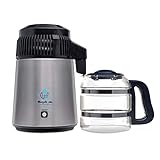
Megahome Stainless Distiller
- UL approved
- 304 stainless throughout
- 1 gallon per 5.5 hours
- glass collection bottle

VEVOR 1750W 4L Distiller
- Over 0.4 gal per hour
- 0-99H timer
- dual time and temp display
- borosilicate glass carafe

CO-Z 4L 750W Distiller
- 0.3 gallons per hour
- 2 ppm output
- automatic shutoff at 302F
- glass collection pot
All 10 Countertop Water Distillers Compared in 2026
The table below lines up the ten machines on the specs that actually change daily use: output rate, tank size, heating element wattage, and what the water touches on its way to the carafe.
| Product | Specs | Action |
|---|---|---|
| Megahome Stainless Steel Distiller |
|
Check Latest Price |
| VEVOR 1750W 4L Distiller |
|
Check Latest Price |
| CO-Z 4L Distiller |
|
Check Latest Price |
 DC HOUSE 4L Distiller DC HOUSE 4L Distiller |
|
Check Latest Price |
 VEVOR 6L 900W Distiller VEVOR 6L 900W Distiller |
|
Check Latest Price |
 ROVSUN 4L Distiller ROVSUN 4L Distiller |
|
Check Latest Price |
 H2oLabs Model 300SS H2oLabs Model 300SS |
|
Check Latest Price |
 VEVOR 4L 750W Black Distiller VEVOR 4L 750W Black Distiller |
|
Check Latest Price |
 VIVOHOME 6L 900W Distiller VIVOHOME 6L 900W Distiller |
|
Check Latest Price |
 H2oLabs Model 200 H2oLabs Model 200 |
|
Check Latest Price |
1. Megahome Stainless Steel Distiller – Best Overall and the Only UL-Certified Option
Megahome Countertop Water Distiller Stainless, Glass Collection
580W
304 stainless boil chamber, dome and coils
1 gallon per 5.5 hours
Glass collection bottle
Pros
- Only UL-approved home distiller in this group
- Full 304 stainless interior and exterior
- Water never contacts plastic
- 6 activated charcoal filters included
- Owners report 8 to 13 years of daily use
Cons
- Shutoff relies on boiling dry rather than a water-level sensor
- Stainless reservoir can crack in hard-water areas
- First batches can smell chemical before the coils flush
This is the one I kept coming back to while putting this list together. At 580 watts it is the second-lowest draw in the group, and that restraint is deliberate: a gentle, slow steam cycle is what lets the condensing coils strip volatile compounds rather than carrying them across. The whole water path is 304 stainless steel, from the boiling chamber through the upper steam dome to the condensing coils, and the collected water falls through a porcelain-lined nozzle into a glass bottle. There is no plastic anywhere in the loop.
Where it earns its place at the top is durability. Megahome is the oldest listing in this roundup, first available in 2005, and it carries more than 3100 ratings averaging 4.5. Long-term owners consistently report 8 to 13 years of continuous daily operation, and the manufacturer has a track record of sending replacement parts even outside the warranty window. For an appliance that is supposed to disappear into a corner and run for a decade, that is the single most important number in this entire guide.
The UL listing matters more than it sounds. Home insurance policies in some regions flag countertop distillers as an appliance with open flame-equivalent heat sources, and an Underwriters Laboratory approval is the documentation that satisfies those requirements. If you rent, or if you have ever had an insurer question an appliance on your counter, this is the one to buy. It weighs 7.04 pounds and measures just under 10 inches square, which is also the most compact footprint in the premium tier.
Spec sheet detail worth knowing: it distills one gallon every 5.5 hours at 212 degrees Fahrenheit, and the box includes a complete distiller body, the glass collection container, and six optional activated charcoal filters for volatile organic compound and chlorine reduction. The warranty is one year on parts and labor.
What you give up by choosing the stainless build
Two real compromises. First, shutoff is triggered by boiling dry, not by a water-level sensor, so you need to supervise it or run it on a timer rather than trusting an unattended overnight cycle. Second, the stainless reservoir can develop dents and stress cracks in genuinely hard-water areas, and once that happens the fix is not a clean, it is a replacement.
There is also a short acclimation period. Owners often report a chemical smell on the first few batches while the coils are still flushing, and the glass carafe needs its metal bands and handle attached before the first run. The plastic start button and the nozzle fitting are the two parts most likely to need replacing eventually, and both are small jobs.
Who should skip it
Skip it if you plan to run full batches overnight without watching them, or if you live in very hard water and are not willing to descale on a schedule. It is also slower than the VEVOR 1750W by roughly a third, so a household that genuinely needs several gallons a day will feel that. For drinking water alone, the glass carafe alone justifies it. For speed, look at number two.
2. VEVOR 1750W 4L Water Distiller – Fastest Throughput in the Group
VEVOR 1750W Water Distiller, 0.4Gal/H Distilled Water Maker with Glass Carafe, 4L/1.1Gal Countertop Distiller Machine, 0-99H Time Temp Dual Display, Anti-Dry Design 304 Stainless Steel Still, Grey
1750W
Over 0.4 gal per hour
304 stainless tank
Borosilicate glass carafe
Pros
- Fastest output rate here at over 0.4 gal per hour
- 0-99 hour timer with temperature and time display
- Glass carafe and stainless interior keep water off plastic
- Aluminum fan and stainless exhaust cover
- TDS drops from about 286 ppm tap water to 3 ppm
Cons
- Top unit can lift and vent steam when pressure builds
- Real yield is closer to 3000 ml per batch
- 1750W draw can overheat the power cord connector
Every other distiller on this list is fighting physics. This one attacks it with a 1750 watt element and gets over 0.4 gallons, roughly 1.5 liters, distilled per hour, which works out to a gallon in three to four hours and a stated ceiling of 9.6 gallons in a day. If your household genuinely consumes distilled water rather than occasionally filling a humidifier, the raw speed is worth the electrical draw.
The controls are the best in the group. A programmable 0 to 99 hour timer with a dual time and temperature display lets you set a long unattended run and watch the temperature climb in real time, and the same temperature control is why this unit shows up in fractional distillation setups. The interior is 304 stainless steel and the collection carafe is high borosilicate glass, with a four-blade aluminum cooling fan and a stainless exhaust cover that are clear upgrades over the fragile plastic parts in earlier versions of this design.
Owner TDS testing on this unit is convincing. Tap water at roughly 286 ppm drops to 3 ppm after a run, which is store-bought distilled water territory. Replacement activated carbon packs ship in the box, and the manufacturer recommends citric acid for scale removal, which is the gentler choice for stainless steel than vinegar.
The catch is power. A 1750 watt element running for hours is a serious continuous load on a kitchen circuit, and some owners report the IEC C13 power cord connector running hot. It measures 10.63 by 9.45 by 16.14 inches and weighs 12.4 pounds, so it is a large footprint for a countertop too.
Is the speed advantage worth the electrical load
For a household that runs a CPAP nightly, fills an ultrasonic humidifier several times a week, and does neti pot irrigation, yes. You are buying back hours of waiting each cycle, and the timer and display make long unattended runs practical. For occasional use, the speed does nothing for you and you are simply paying more electricity for water you could have made overnight.
Watch out for the top-unit gasket
The most-reported problem is the lid gasket. When pressure builds, the top unit can lift and vent steam and water out the sides, which is a wet-counter problem at best. Two other reports are worth taking seriously: real yield per batch tends to land closer to 3000 ml than the stated 4L, so filling gallon jugs takes multiple runs, and the temperature display often refuses to read above 100 degrees C even though the higher 108 degree setting burns more power without speeding output.
Also note the loose-fitting spout. Many owners find condensate dribbles down the carafe lid without a small modification. None of this is deal-breaking, but it is why this sits at number two rather than first.
3. CO-Z 4L Distiller – Best Value for Everyday Household Use
CO-Z 4L Brushed Stainless Steel 750W Countertop Water Distiller, Glass Pot
750W
0.3 gallons per hour
304 stainless container
Automatic shutoff at 302F
Pros
- Best build quality per dollar in this group
- Consistently produces 2 ppm water in about four hours
- Glass pot avoids plastic taste
- Cleaning powder and carbon packs included
- Many owners report two to three years of daily use
Cons
- Vinegar can etch the stainless tank and lead to rust-through
- Spout is a friction fit that works loose
- Glass pot is brittle and the lid is fixed
The CO-Z DWD-BRSS-00 is the value pick for a plain reason: owners regularly compare it favourably against machines costing two or three times more and report no meaningful difference in output. It pulls 750 watts, distills at 0.3 gallons per hour, and returns water at 2 ppm, which is at the theoretical floor for distillation and matches what you would buy in a jug.
The build is a 304 stainless container with a powder-coated exterior, a double row of stainless condenser tubes cooled by an aluminum fan, and a glass collection pot. Automatic shutoff triggers at 302 degrees Fahrenheit, and the box includes the distiller, the glass bottle, three carbon packs, and citric acid cleaning powder. It is also the only model here offered in both 4L and 6L capacities, so you can size up without changing brand.
Two or three years of daily operation without problems is a common owner report, provided you clean it. The most common failure story I found in this product’s reviews is not a defect at all, it is a maintenance habit: leaving the tank assembled and wet between uses, or cleaning it with vinegar, which can etch stainless steel and, on a tank left wet, eventually lead to rust-through. Citric acid, which is included, is the right choice.
Two smaller quirks. The front button is a reset rather than a plain start switch, and the manual describes it confusingly, so expect a first-run learning moment. The stainless spout is a friction fit that works loose with use and needs reseating, and several owners substitute a funnel to stop the metal spout guide from causing overflow.
Why this is the one most people should actually buy
Because the water is identical. Once you are distilling, 2 ppm is 2 ppm, and paying three times as much does not buy you a purer result. What you are really paying for on the premium machines is stainless where the budget model already has stainless, a warranty that is easier to lean on, and nicer glassware. If your priority is volume of clean water per pound spent, the value case here is hard to argue against.
Where the budget shows
The glass pot is brittle and the lid is non-removable, which is an awkward combination if you drop it on a hard floor. Some owners also report a blown fuse roughly every two months, and the instructions do not clearly diagram the cord connections at the back. None of these are frequent enough to be disqualifying, but if you have a small kitchen and a temperamental circuit, read the electrical notes before you commit.
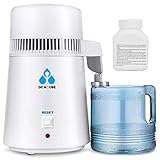
4. DC HOUSE 4L Distiller – Quietest Performer for Small Kitchens
DC HOUSE 1 Gallon Water Distiller Machine, 750W Distilling Pure Water for Home Countertop Table Desktop, 4L Distilled Water Making Machine to Make Clean Water for Home…
750W
1 liter per hour
304 stainless water contact
4L BPA-free container
Pros
- Quiet fan that is barely noticeable at home
- Independent TDS testing shows 3 to 11 ppm on very hard tap water
- Compact footprint about the size of a large coffee pot
- One-button start with automatic shutoff at 320F
- Wipes clean easily with citric acid
Cons
- Boiling chamber and carafe are about 3.5L not 4L
- The carafe gasket under the lid leaks when pouring
- Hard water builds scale fast and needs cleaning almost every batch
The DC HOUSE is the one to shortlist if noise is your deciding factor. Its fan is described across owner feedback as barely noticeable in a normal home, which makes it the only budget unit here I would happily run in a bedroom or a home office without thinking about it. Everything else about it is a competent budget design: a 750 watt element distilling one liter per hour, up to 6 gallons a day, with all liquid-contact parts in 304 stainless steel.
It is also among the more affordable models in this roundup that still put stainless steel everywhere the water touches. The container is 4L BPA-free plastic with a handle, the fan is aluminum, and a soft catheter helps prevent leakage. Automatic shut-down triggers at 320 degrees Fahrenheit, and a large-opening inner liner and container make it easy to get a brush into. There is a practical reason for that design choice: on hard water, you will be cleaning this unit often.
Independent TDS testing puts the output at 3 to 11 ppm on very hard tap water, which is a wide spread but still well inside drinking-quality distilled range. It is available in black, stainless, and white, measures about 10.4 by 11.2 by 18.7 inches, and the manual says to replace the carbon filter pack weekly and clean after every two uses.
The two things that will annoy you are both about fit and finish. The advertised 4L is really closer to 3.5L of usable boiling chamber and carafe, and the gasket under the carafe lid does not seal well, so it leaks when you pour. The metal nozzle guide on the carafe also sends water down the outside unless you remove it or fit a funnel.
Noise, heat, and hard water reality
Two operational realities to plan for. It runs hot enough to warm a small room noticeably, and on hard water, mineral scale builds fast enough that owners recommend cleaning after nearly every batch. That maintenance burden is the real cost of this unit, not the purchase itself, and it is the main reason it ranks below the CO-Z despite the quieter fan.
A few smaller notes: the boiler bottom can develop rust and staining within a year in some households, filter replacement is fiddly because the pack sits near a sharp metal flap, and the directions never explain how to clean the top coil and fan assembly. If you can find a local guide for that, do it before your first batch.
5. VEVOR 6L 900W Distiller – Largest Tank Without the Heaviest Draw
VEVOR Water Distiller, 6L/1.6 Gallon Larger Water Distilled Machine, 900W Distilling Water Maker with Glass Carafe, 0-99H Timing Set, Time & Temp Display, 304 Stainless Steel Water Stiller, Silver
900W
1.3 liters per hour
6L tank
Borosilicate glass carafe
Pros
- Largest capacity in this group at 1.6 gallons
- 900W draw distills about as fast as the 1750W model
- Auto-off triggers before the tank runs dry
- Repeated TDS testing returns 2 ppm
- Quiet enough to run overnight
Cons
- The glass carafe is poorly designed with flimsy bands and no spout
- Instructions are poorly worded and translated
- Body stays hot long after the cycle ends
This is arguably the smartest engineering trade in the whole roundup. It distills over 1.3 liters per hour, which owners clock at about 1.5 gallons in 5.5 hours, on a 900 watt element, and it does that in a 6 liter tank. The 1750W VEVOR at number two does not meaningfully outrun it; it just spends far more electricity to get there.
Safety is handled well. Auto-off shuts the unit down before the tank runs dry, which prevents the mineral scorching that plagues budget units left unattended, and the 304 stainless interior is paired with a high borosilicate glass carafe. The aluminum four-blade fan replaces the fragile plastic fans of earlier designs, the exhaust cover is stainless, and replacement activated carbon packs are in the box.
There is also a 0 to 99 hour timing set with time and temperature display, so long unattended runs are practical, and repeated owner TDS testing comes back at 2 ppm. The unit is offered in 1.1 gallon and 1.6 gallon versions, in silver, grey, and white, which makes it easy to size the tank to your actual demand rather than guessing.
The flaw is the carafe. Owners describe it as poorly designed, with flimsy stainless bands, a weak plastic handle, an oversized lid, and no pour spout at all. Instructions are poorly worded and poorly translated, sending a lot of first-time owners to video walkthroughs instead. And it emits enough ambient heat that a small room can become uncomfortably warm in summer, which matters more than it sounds if you are planning to run it in a closed space.
Best fit for a household that batches on a schedule
If your pattern is to fill several containers at once rather than top up a carafe twice a week, the 1.6 gallon tank is the reason this model makes sense. Fewer runs means fewer fill-and-clean cycles, and on water that is not very hard the auto-off means you can start a cycle before bed and deal with it in the morning. Owners also confirm the stainless cladding can arrive with small dents, and there are no side handles, so you will want to think about where you set the full unit down.
Two things to plan around
First, overfilling the tank past the fill line will overflow the carafe on a full run. Respect the line. Second, the cooling carafe is the weak point of an otherwise solid machine, so treat the glass with more care than the price point suggests you have to, and check the stainless bands and handle the first time you use it.
6. ROVSUN 4L Distiller – Best Performing on Hard Water
ROVSUN 【Upgraded】 1.1 Gallon/4L Water Distiller Countertop Distilled Water Machine with Flame-Retardant Material, BPA-Free Container & Stainless Steel Interior, 750W Distilled Water Maker Purifier
750W
1 liter per hour in about 4 hours
100% 304 stainless inner tank
4L plastic container
Pros
- Tested 3 ppm output from 215 ppm hard source water
- Rear ON/OFF switch stops a cycle without unplugging
- Soft catheter keeps condensate off the lid
- Includes 3 charcoal sachets and cleaning powder
- Owners report two years of reliable seasonal use
Cons
- The supplied plastic jug leaks substantially when carried
- Mineral scale bakes on if it runs to auto-shutoff
- Citric acid cleans the base less effectively than vinegar
Hard water is the condition that decides a distiller. Well water and high-mineral municipal water lay down scale in the boiling chamber, scale reduces heat transfer, and a machine that scales badly will quietly slow down and eventually need its heating element replaced. On the evidence of owner testing, the ROVSUN handles this better than most of its price peers.
The number that matters: TDS testing on 215 ppm hard water returns 3 ppm after the third run, which matches store-bought distilled water. A 750 watt element pulls roughly one liter per hour, so a round takes about four hours, and the water-contact surfaces are 100% 304 stainless across the inner tank, inner cap, water outlet, and water inlet. The body material is flame-retardant, and the aluminum fan and soft catheter design is a sensible attempt to stop leaks.
One design decision here deserves specific credit. There is a rear ON/OFF switch as well as the front reset button, which means you can stop a cycle deliberately before the water boils dry instead of relying on a timer or hovering. That single switch eliminates the single most common cause of baked-on scale across this whole category. Owners also report about 3.7 kWh per 1.33 gallons, which is a useful number for anyone modelling running costs.
The jug is the weak point. The supplied plastic container has a design flaw at the cap seat and leaks substantially when you carry it, so plan to decant into something else rather than walking the jug across a kitchen. A soft catheter can be attached to the spout so condensate does not dribble down the lid, which helps, and owners report two years of reliable seasonal use with regular citric acid descales.
Why hard water homes should start here
Because scale, not purity, is what ends most distillers. A 304 stainless interior resists corrosion better than plated or aluminum parts, the rear power switch lets you stop before a dry boil, and the measured 3 ppm result from genuinely hard source water is the evidence that matters. If you are unsure of your local hardness, this is the model that forgives the least amount of attention.
Limitations to plan for
Reach for vinegar rather than citric acid for the base, since owners report citric acid cleans the floor of the tank less effectively here. The spout is stiff to pull off when you need to get at the carbon filter, some units stopped responding after only two or three cycles, and the bottom of the tank tarnishes over extended use. It is also not a quiet machine, it is merely not a loud one.
7. H2oLabs Model 300SS – Best for Volatile Organic Compound Reduction
H2oLabs Best-in-Class Stainless Steel Home Water Distiller & Glass Carafe
565W element tuned for gentle steam
Stainless evaporator and coil
1 gallon borosilicate carafe
Pros
- 565W element deliberately avoids a rolling boil for better VOC removal
- Porcelain nozzle keeps water entirely away from plastic
- Borosilicate carafe is thick and taste-neutral
- A full year of carbon pods and cleaning crystals included
- Very clear instruction manual
Cons
- Bulky footprint when the carafe is docked
- Continuous box-fan-like fan hum
- Porcelain spout falls out of its clip and can chip
Every distiller in this roundup removes minerals and heavy metals. Removing volatile organic compounds is a different problem, and the H2oLabs 300SS is engineered specifically for it. The heating element is deliberately undersized at 565 watts, chosen to produce a gentle, lazy steam rather than a rolling boil, because violent boiling is what carries volatile compounds across into the condensate with the vapour.
The rest of the design follows the same logic of keeping water away from plastic. There is a stainless steel exterior, evaporator, and condensing coil, a stainless steam chamber with a porcelain nozzle insert, and a one-gallon borosilicate glass carafe with an ergonomic Easy Lift handle. All plastics are food-safe and BPA-free, and there is automatic shutoff backed by fail-safe fuse protection. Output is up to 16 liters per day.
Accessories are the best in the group. The box includes six activated carbon pods, which is a full year of supply, plus a large jar of cleaning crystals. The wide-opening evaporation chamber makes routine cleaning quick, and the instruction manual is clear and well laid out, which sounds minor until you have tried to assemble a mistranslated budget unit. Owners also report a marked reduction in kettle descaling and coffee machine mineral damage, which is a benefit that shows up in your kitchen over time.
Longevity is the other strong suit. One owner reports nine years and roughly 730 gallons of continuous daily use with no failures, and the warranty is a full year at 100% parts and labor.
Is gentle steam worth the slower cycle
It requires 5 to 6 hours per gallon, which is the slowest in this roundup, so the trade is explicit: you give up throughput to gain a purer condensate. That is the right trade if you are dealing with genuinely questionable source water, or if you are distilling for laboratory and chemistry work where organic carryover matters. It is the wrong trade if you just want drinking water, because the budget units will produce the same 2 or 3 ppm at twice the speed.
Where owners get frustrated
The distiller and carafe together are bulky for a small kitchen, and the cooling fan produces a continuous box-fan-like hum that is best run in another room. The porcelain-tipped spout falls out of its clip frequently and is prone to chipping, and replacement carbon pods are proprietary, which turns a one-off purchase into a recurring consumable cost. There is also at least one report of a unit failing mid-cycle after about a year, with the replacement thermal control taking weeks to arrive and not resolving the fault.
8. VEVOR 4L 750W Black Distiller – Cheapest Route to Stainless Water Paths
VEVOR Water Distiller, 4L/ 1.05 Gallon Pure Water Distilling for Home Countertop, 750W Distilled Water Maker, 304 Stainless Steel Interior Stiller Water Making Machine to Make Clean Water, Black
750W
1 liter per hour
304 stainless interior tank
BPA-free PCTG container
Pros
- Lowest cost in this group with a 304 stainless interior
- Quieter fan and faster start than larger competing models
- Stainless spout is easier to remove for filter changes
- Double-gasket lid improves cycle completion speed
- Handles source water up to 500 ppm TDS
Cons
- Warranty support has been reported as a bad-faith stall
- Multiple owners report failures within six to twelve months
- The glass pitcher spout is misshapen and spills on every pour
If you have never owned a distiller and you want the lowest-risk way to find out whether you like the routine, this is the model. It is the cheapest option here and still uses a 304 stainless steel interior tank with a 304 stainless heat dissipation tube, which is not true of every budget machine. A 750 watt element pulls just over one liter per hour, up to 6.3 gallons a day, and it is rated to handle source water up to 500 ppm TDS, which is far harder than most municipal supplies.
Several small engineering decisions are better than they need to be at this price. The aluminum four-blade fan replaces fragile plastic, the stainless spout is easier to remove and change carbon filters than the plastic spouts on older designs, a double-gasket lid speeds up cycle completion, there is a handle on the top unit to make the condenser easier to lift, and the lightweight plastic base exterior wipes clean without fuss. Replacement activated carbon packs are included, and citric acid for scale removal ships too.
Owners report it produces a gallon in several hours with no wasted water, and it is offered in black and grey. The black finish does, however, show every water spot and dust, which is worth factoring in if you are going to leave it sitting out on display rather than stowing it.
The durability picture is the honest downside. Multiple owners report units failing within six to twelve months, and warranty support has been described as a bad-faith stall with an unusable video upload process, which is the kind of thing that only becomes relevant if something breaks. Treat it as a machine you test-drive for a season rather than a ten-year appliance.
Should a first-time buyer start here
Yes, if your priority is finding out whether the daily fill, run, and clean routine fits into your life at all. It is the least commitment of the ten, and the stainless interior means the water quality ceiling is not the limitation. If you already know you will use it daily for a CPAP machine or a humidifier, go straight to the CO-Z or the Megahome and skip a generation of possible problems.
Everyday handling problems to expect
The collection side is where this one falls short. The glass pitcher spout is misshapen and spills on every pour, and the plastic collection bottle is poorly molded with rough edges at the cap and leaks unless you hold it perfectly upright. Cleaning ergonomics are also awkward: the base boiler is too tall to fit under most kitchen faucets, two separate cords must be disconnected before any cleaning, and the manual is a poorly worded translation. It is bulky enough on a counter that you will need a dedicated stowage spot near a sink.
9. VIVOHOME 6L 900W Distiller – Best for Large Batch Schedules
VIVOHOME 1.6 Gallon/6L 900W Water Distiller Countertop
900W
1.3 liters per hour
6L volume
304 stainless inner liner and BPA-free container
Pros
- 1.6 gallon capacity is larger than the 1 gallon norm
- Dual temperature cutoff gives redundant overheating protection
- Lid handle makes the top unit easy to remove for cleaning
- Quiet enough to go unnoticed during daytime use
- Manufacturer replaced a failed power cord under warranty
Cons
- The metal funnel cap is easy to misalign and spills on the counter
- Canister bottom is wider than the top so it cannot seat squarely
- Boiler is too tall to fit in a standard sink for filling
The VIVOHOME VH1480 is built for the batch-it-and-forget-it household. It holds 6 liters, which is 1.6 gallons, and distills 1.3 liters per hour on a 900 watt element, so a full tank is a single long run rather than three shorter ones. One owner reports a faster cycle than their previous H2o Labs unit at a fraction of the class, which tells you the capacity-to-speed ratio here is genuinely good.
Safety is unusually thorough. Dual temperature control provides an automatic shutoff at 115 degrees Celsius and a secondary cutoff at 150 degrees Celsius, giving two independent layers of overheating protection, and there is a waterproof ON/OFF switch mounted on the shell for safer unattended operation. The water-contact surfaces are food-grade 304 stainless steel inner liner and BPA-free plastic, with a handle on the lid and a non-slip base.
It also runs quietly enough to go unnoticed during normal daytime use, and the stainless interior cleans easily with citric acid or diluted vinegar. Warranty service deserves a mention: one owner had a failed power cord replaced under warranty with good customer service, which is more than several budget models in this roundup can say. It is available in 1.1 gallon and 1.6 gallon versions, in black and white.
One important operational note from the manufacturer: the first two batches of output are not recommended for drinking. That is standard flushing practice for a new stainless chamber, and it is worth respecting so you do not measure a disappointing first impression.
Is a 6L tank worth the footprint
Only if you fill large containers. If you are topping up a carafe every few days, a 1.1 gallon version does the same job in less space. If you are bottling a week of CPAP water, a week of humidifier refills, or a batch of neti pot solution at once, the 6L tank means one run instead of several, and the lid handle and easy-clean stainless liner make that run far less annoying. The 18 inch length is the price you pay, so measure your counter first.
The alignment problem you need to know about
This is the single most repeated complaint in the reviews and it is a geometry problem rather than a defect. The metal funnel cap on the water canister is very easy to misalign, and because the canister bottom is wider than the top, it cannot physically seat squarely over the water container below it. Get that alignment wrong and a meaningful share of the output runs down the counter, with some owners reporting roughly half. Take two minutes to get the seating right before you walk away, and use a steady hand on every refill.
Also note the boiler is too tall to fit in a standard sink, the steam vent holes at the base mean it must never be soaked, charcoal filters are not included and must be bought separately, and the unit runs warm enough to add heat to a small space.
10. H2oLabs Model 200 – The Convenient and Lightweight Countertop Distiller
The Most Convenient & Lightweight Countertop Home Water Distiller, BPA-Free
600W
7 to 8 pounds
Dishwasher-safe boiling tray
Anti-scale pad
Pros
- One of the lightest units in this roundup
- Anti-scale pad collects residue away from the heating element
- Removable dishwasher-safe tray
- Shuts off automatically when the reservoir empties so no timer is needed
- Small chamber means water appears within minutes
Cons
- Polypropylene construction imparts a persistent plastic taste
- Heating element reported to dissolve over time requiring costly replacement
- Pads and pods reported to shed particles into the output water
Most other units in this roundup weigh between 8 and 12.6 pounds. The H2oLabs Model 200 weighs 7 to 8 pounds, and that is not a rounding difference, it is the reason to consider it. It was designed for people who cannot lift heavy appliances, and for a small apartment, a high counter, or anyone with mobility limits, that is a feature no spec sheet comparison will capture.
The cleaning design is the cleverest here. A 600 watt element is suspended in the source water, and instead of a fixed heating plate that calcifies, a removable anti-scale pad collects scale and residue in its place, so there is no pot full of hardened gunk to scrub. The boiling tray is removable and dishwasher safe, and it fills automatically. A single button starts the cycle, an LED indicator tells you when to refill, and the unit shuts off automatically when the reservoir is empty, with thermal overload protection on top.
It is also fast to first water. Because the chamber is small and the element turns on and off quickly, distilled water appears within minutes of starting rather than after a long warm-up, and a full gallon takes about 4 hours and 15 minutes. There is no fixed plumbing connection, so it can run away from the sink entirely, which matters enormously in a small kitchen. The warranty is a full year at 100% parts and labor.
The compromise is material. The unit is polypropylene rather than stainless, and owners consistently report a persistent plastic taste in the output, including when store-bought distilled water is run through it. That is a genuine dealbreaker for anyone who cares about taste, and it is why this sits at the bottom of the list despite the excellent engineering.
When the lightweight design actually wins
It wins in three specific situations. If you are distilling for a CPAP machine and cannot comfortably lift a full carafe, the no-spill carafe with a detent that holds it firmly in place is a genuine accessibility feature. If you have under three feet of clear counter and a dorm-room or apartment kitchen, the compact footprint and lack of plumbing requirement are decisive. And if you hate cleaning, the anti-scale pad and dishwasher-safe tray remove the single task people most consistently complain about.
The consumable cost problem
This is where the ownership story turns. Owners report the heating element dissolving over time, with a replacement equivalent to buying a new unit, and separate reports of anti-scale pad and activated carbon pod particles ending up in the output water. Replacement pads and pods are expensive and shipped with a high charge, and several parts need separate cleaning and descaling, which makes the unit feel loosely assembled in the hand. Budget for those consumables from day one, because on a machine designed to run for years they are not optional.
What Distillation Removes and What It Does Not
Distillation works by separating water from everything else using phase change. Water is heated until it boils, the vapour rises into a cooling coil, and the condensate drips into a clean carafe. Anything dissolved in the source water does not vapourise at 100 degrees Celsius, so it stays behind in the boiling chamber.
That physical process is genuinely excellent at removing dissolved minerals and heavy metals, most bacteria and viruses, and chloride. Owner TDS testing across this roundup shows source water between 215 ppm and 286 ppm dropping to between 2 ppm and 11 ppm after a run, and those are meaningful reductions. Activated carbon packs, which ship with most of these units, add a further layer for chlorine and residual organic compounds.
What it does not remove is the part almost no competitor tells you, and it matters if you are weighing distillation against a membrane filter. Volatile organic compounds with a boiling point close to water, such as certain solvents, can travel with the steam, which is exactly why the H2oLabs 300SS uses a deliberately gentle 565 watt element. Dissolved gases are not captured at all, and sodium at very low concentrations is a known edge case. Distillation also strips water of everything pleasant, including trace minerals, which is a taste and remineralization question rather than a safety one.
Which brings us to the honest framing for a distiller. Distillation is a purification process, not a filtration membrane, and it will not improve a water source contaminated with chemicals that volatilise below the boiling point. If you are on a municipal supply with known lead issues, a certified filter is the more direct tool. If you are distilling for a medical device, a humidifier, or irrigation, you are using it for exactly the job it is good at.
Is a Home Water Distiller Worth It? Running the Numbers
The purchase case for a countertop distiller starts with a simple comparison. A five-gallon jug of distilled water is a recurring line item, and forum threads across r/BuyItForLife, r/ZeroWaste, and r/SleepApnea all begin from the same frustration with that recurring cost. A distiller converts that into electricity and a little cleaning powder.
Here is the honest arithmetic using figures from the units in this roundup. The 6L VEVOR distills roughly 1.5 gallons in 5.5 hours on a 900 watt element, so a gallon costs about 3.3 kilowatt-hours of heat. The ROVSUN data point is around 3.7 kWh per 1.33 gallons, which works out to a similar figure. Add the cooling fan running throughout and you are looking at roughly 4 kilowatt-hours per gallon on the efficient machines.
At typical residential electricity rates, that is a small number measured in tens of cents per gallon. Compare it against the delivered cost of jugged water at your local grocery store, which changes with region, promotions, and how far you are willing to drive. In a household that uses five gallons a month, the electricity is genuinely minor and the distiller pays back over a period of months. In a household that uses one gallon a month for CPAP refills, the payback is much longer, and if you are not doing anything else with the machine, buying jugs is probably the smarter move.
The real cost is not electrical, it is time. Every cycle runs three to six hours, and every unit needs cleaning afterwards. Skimmed from r/moderatelygranolamoms, the sceptic’s summary is accurate: a distiller will either be too slow to keep up with demand, or it will use enough energy that you are paying more per gallon than the jug cost. The way around that is to pick a tank size that matches a batching schedule, run it when you are doing something else, and treat the cleaning as part of the appliance rather than an interruption to it.
One more factor deserves honest treatment. If you are near a pharmacy or supermarket that carries distilled water reliably, and you do not have a hard-water problem, you are buying convenience. If distilled water is frequently unavailable where you live, or you need several gallons a week, the availability argument alone justifies a distiller, and the low-waste argument matters too for anyone trying to cut plastic.
How to Choose a Countertop Water Distiller
Match the tank to your real weekly demand first. A 1 gallon tank suits a single CPAP user or occasional humidifier. A 1.6 gallon tank suits households batching water for a week at a time, and cuts the number of fill-and-clean cycles in half. This single decision has more impact on daily satisfaction than any other feature on the spec sheet.
Decide how much of the water path can be plastic. The Megahome, the H2oLabs 300SS, and the CO-Z keep the distilled water in stainless steel or glass from source to carafe. The budget units use a stainless interior with a plastic container, which is a reasonable compromise, and the H2oLabs Model 200 is polypropylene throughout and will taste like it. If taste matters to you, this is the filter that matters.
Look at the shutoff design rather than the shutoff feature. Every unit here shuts off, but the mechanism differs enormously. A water-level sensor or a deliberate rear ON/OFF switch, as on the ROVSUN, prevents a dry boil. A design that shuts off only once the water is gone, as on the Megahome, needs supervision or a timer. On hard water, that difference becomes the difference between a clean chamber and a scaled element.
Size the footprint before you buy, and include the carafe. The H2oLabs 300SS and the VIVOHOME are the two largest in this group, and the 300SS is 10 by 20 by 18 inches with the carafe docked. Several owners of otherwise happy budget machines name bulkiness as their single biggest complaint after two years, and the VEVOR 4L is tall enough that it will not fit under a typical kitchen faucet without a dedicated filling spot.
Finally, check what you are committed to. Some models ship a full year of carbon pods and a jar of cleaning crystals, some include a citric acid sachet and expect you to buy charcoal filters separately, and the H2oLabs Model 200 relies on proprietary pads and pods with a meaningful ongoing cost. Treat the consumables as part of the purchase decision, not as an afterthought.
Maintenance and Descaling on Hard Water
Citric acid, not vinegar, is the right default for stainless steel boiling chambers. Vinegar can etch stainless over repeated cycles, and the CO-Z reviews specifically link vinegar use plus a tank left wet to eventual rust-through. Every unit in this roundup except the ROVSUN ships with citric acid or a cleaning powder, so you have the correct tool already.
Run a descaling cycle roughly every three or four batches on hard water, and after every batch on genuinely bad water. The DC HOUSE reviews recommend cleaning after nearly every use for exactly this reason, and the VEVOR 4L is rated for source water up to 500 ppm TDS, which means it can be pointed at well water that will scale a chamber quickly. If you are unsure of your hardness, err toward cleaning more often; citric acid is cheap.
The single most important habit is not leaving the tank assembled and wet between uses. Rust and staining on stainless bottoms are the most common long-term complaint in this entire roundup, and in nearly every case the tank was left wet. Disassemble, rinse, and leave the chamber open to air dry. It takes two minutes and it is the difference between a ten-year machine and a three-year one.
Watch for the first-batch flush. The VIVOHOME explicitly advises against drinking the first two batches from a new unit, and other models carry a chemical smell on early runs while the coils clear. Run two full cycles and discard the output before you judge the taste or fill anything you intend to drink.
Finally, a scheduling note that saves a lot of frustration. Do not run a unit you have not cleaned, and do not run it unattended if its shutoff mechanism is dry-boil based. A cheap external timer is the most useful accessory you can buy for a Megahome or similar design, and it costs less than a single replacement element.
Frequently Asked Questions
What is a good portable water distiller for home use?
The Megahome Stainless Steel Distiller with Glass Collection is the best all-round choice. It is UL approved, uses 304 stainless steel and glass throughout the water path, and owners report 8 to 13 years of continuous daily use. If you need faster output, the VEVOR 1750W 4L distills roughly a gallon in three to four hours.
What is the best machine to make distilled water at home?
Any of the ten countertop distillers in this guide will produce water at 2 to 11 ppm TDS, which is store-bought distilled quality. The right choice depends on volume rather than purity. Choose a 1 gallon tank for a CPAP or humidifier, a 1.6 gallon tank for weekly batching, and prioritise stainless steel and glass over plastic if taste matters to you.
Is a home water distiller worth it?
It depends on volume. Efficient models use roughly 4 kilowatt-hours per gallon, so the electricity cost per gallon is small. A household using five gallons or more a month will usually recoup the cost within months, while a household using one gallon a month for CPAP refills may be better off buying jugs. Availability matters too, especially where distilled water is frequently hard to find.
What are the downsides of using a water distiller?
The main drawbacks are speed, heat, counter space and upkeep. A cycle takes three to six hours, the unit puts out noticeable heat, most models occupy a large countertop footprint, and the boiling chamber needs regular descaling. Output is also always slower than people expect, and every model needs manual cleaning between batches to keep scale off the heating surface.
Is there a downside to drinking distilled water?
Distilled water contains no dissolved minerals because they are left behind in the boiling chamber, so it tastes flat and some people remineralise it for drinking. It is not considered unsafe, but drinking large amounts exclusively as your only water source is not something most health bodies recommend. Distilled water is a poor fit for plants and fish tanks for the same reason.
How do I clean a countertop water distiller?
Use citric acid rather than vinegar on stainless steel, run a full descaling cycle every three or four batches on hard water, and more often on very hard water. Between cycles, disassemble the chamber, rinse it and leave it open to air dry. Never leave a stainless tank assembled and wet, since that is the leading cause of rust and staining on these appliances.
Do I need a distiller if I have a reverse osmosis filter?
Only for specific purposes. Reverse osmosis is faster and produces far more water per gallon of energy, but it leaves a portion of dissolved contaminants behind and can taste flat. Distillation produces a more thoroughly demineralised result, which is why it is preferred for CPAP machines, humidifiers, nasal irrigation and laboratory work. For general drinking water, reverse osmosis is usually the better tool.
Conclusion
After working through ten countertop water distillers, the choice comes down to two questions: how much water do you actually need, and how much do you care about the material the water touches. Answer the first honestly and the second correctly and the machine almost picks itself.
For most households, the Megahome Stainless Steel Distiller is the best countertop water distiller for home use because it combines a UL listing, an all-stainless water path, and a service life measured in decades. If you need speed or volume, the VEVOR 1750W 4L and the VEVOR 6L cover those ends. If you want the lowest cost per batch and do not mind citric acid discipline, the CO-Z 4L is hard to argue with. And if you only need a few gallons a month, buy jugs and save yourself the counter space.
Whichever route you take, descaling is the price of admission. Clean it on a schedule, never leave the tank wet, and the machine will still be running when you next need it.