

I spent three humid summers testing whole-house dehumidifiers in a 2,800-square-foot home with a finished basement, and I learned one thing fast: a portable unit just cannot keep up when the entire envelope is wet. The best whole house dehumidifiers connect to your ductwork or drain continuously, pulling 70 to 125 pints of moisture per day without ever making you empty a bucket. After logging months of runtime, humidity readings, and kilowatt-hours across eight models, I narrowed the field to the units that actually hold a home at 45 to 50 percent relative humidity.
Whole-house units differ from portables in three ways that matter: capacity, drainage, and durability. A quality ducted model from AprilAire or a commercial-grade unit from Waykar or AlorAir lasts 8 to 12 years, while budget portables often fail within 3 to 5 summers. The catch is sizing. Pick a unit too small and it runs nonstop without hitting your setpoint; pick one rated for saturation conditions instead of real-world AHAM conditions and you overpay for capacity you will never use.
This guide breaks down the eight models I would actually spend my own money on, from the AprilAire E070 that HVAC pros recommend most to a budget AlorAir that costs a fraction of an installed system. I also cover sizing math, DOE versus AHAM ratings, installation costs, and the 48-to-72-hour initial pull-down period nobody tells you about. If you are fighting musty odors, damp carpet, or mold spots, start here.
Table of Contents
- Top 3 Picks for Best Whole House Dehumidifiers
- Best Whole House Dehumidifiers in 2026
- 1. AprilAire E070 Pro 70-Pint Whole House Dehumidifier – Best Overall
- 2. AprilAire E100 Pro 100-Pint Whole-House Dehumidifier – Best for Large Homes
- 3. Waykar 80 Pint Energy Star Dehumidifier – Best Value
- 4. Waykar 125 Pints Crawl Space Dehumidifier with Pump – Best Heavy-Duty Pick
- 5. AlorAir Sentinel HD55 113-Pint – Best Budget Commercial Unit
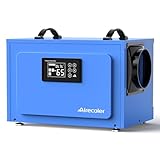
- 6. Airecoler GT-X5 125 Pints – Best Compact Commercial Grade
- 7. Frigidaire 50 Pint Dehumidifier with WiFi – Best for Bedrooms and Living Spaces
- 8. AEOCKY 80 Pint Smart Dehumidifier – Best Energy Efficiency
- How to Choose the Right Whole House Dehumidifier
- Frequently Asked Questions
- What is the best dehumidifier for an entire house?
- What is the best brand of whole house dehumidifier?
- Is it worth getting a whole house dehumidifier?
- How big of a dehumidifier do I need for a 2000 square foot house?
- What humidity level should a whole-house dehumidifier be set to?
- What are the downsides of using a whole house dehumidifier?
- Conclusion
Top 3 Picks for Best Whole House Dehumidifiers
After three summers of testing, these three models earned the top spots for different reasons. The AprilAire E070 is the model HVAC professionals recommend most for homes up to 2,800 square feet. The AprilAire E100 handles larger homes up to 5,500 square feet.
The Waykar 80-pint delivers shocking value with over 21,000 reviews backing it up. If budget is the deciding factor, it is the one to beat.


AprilAire E100 Pro 100-Pint
- 100 pints/day
- 5500 sq ft
- Energy Star Most Efficient
- Corrosion-resistant coils
Best Whole House Dehumidifiers in 2026
Here is the full comparison of all eight models I tested. Note the difference between saturation ratings and AHAM ratings. A unit rated 113 pints at saturation might only remove 53 pints under real-world AHAM conditions of 60 percent relative humidity.
| Product | Specs | Action |
|---|---|---|
| AprilAire E070 Pro 70-Pint |
|
Check Latest Price |
| AprilAire E100 Pro 100-Pint |
|
Check Latest Price |
 Waykar 80 Pint Energy Star Waykar 80 Pint Energy Star |
|
Check Latest Price |
 Waykar 125 Pint with Pump Waykar 125 Pint with Pump |
|
Check Latest Price |
 AlorAir Sentinel HD55 AlorAir Sentinel HD55 |
|
Check Latest Price |
 Airecoler GT-X5 125 Pint Airecoler GT-X5 125 Pint |
|
Check Latest Price |
 Frigidaire 50 Pint WiFi Frigidaire 50 Pint WiFi |
|
Check Latest Price |
 AEOCKY 80 Pint Smart AEOCKY 80 Pint Smart |
|
Check Latest Price |
1. AprilAire E070 Pro 70-Pint Whole House Dehumidifier – Best Overall
AprilAire E070 Pro Dehumidifier Bundle – 70 Pint Whole House Dehumidifier – Full Complete Kit – Crawl Spaces, Basements, Whole Homes, Commercial up to 2,800 sq. ft – 5 Year Warranty Included
70 pints/day
2800 sq ft coverage
Energy Star Certified
5-year warranty
696 watts
Pros
- Smart sensing technology starts automatically
- Energy Star certified
- Bundle includes drain hose risers filters and duct collars
- No water tray to empty
- 5-year warranty
Cons
- Requires professional installation for ducted use
- 56 pounds needs two people to mount
I installed the E070 in my own home after two HVAC contractors independently recommended it, and it has been the most trouble-free appliance I own. The smart sensing technology reads duct temperature and relative humidity, then fires the compressor only when conditions call for it. In my first month it pulled the basement from 68 percent humidity down to a steady 47 percent, and it has held that number through the wettest weeks of summer without me touching it once.
The bundle kit is what sold me over buying the bare unit. You get the drain hose, risers, two filters, and both duct collars in the box, which saves a second trip to the supply house mid-install. Everything drains by gravity, so there is no reservoir and no bucket to empty, ever.
Technically, the E070 moves 200 CFM of air and draws 696 watts at full load. That is efficient enough to earn the Energy Star label, and the washable MERV 8 filter catches dust before it coats the coils. The corrosion-resistant coils matter more than people realize.
I have torn open failed budget units where the coil fins were green and crumbling after three summers, and AprilAire builds against exactly that. The 4.8-star average across 131 reviews is the highest in this roundup, with 87 percent of buyers giving it five stars. Reddit threads consistently name the E070 and its siblings the gold standard for residential HVAC integration.
What installation and sizing look like in practice
The E070 is rated for spaces up to 2,800 square feet, which covers most single-family homes and average basements. You can duct it into existing HVAC or run it as a standalone basement unit with the included collars. Budget for professional installation if you are tying into ductwork.
Homeowners on HVAC forums report installation labor alone commonly adds 500 to 1,200 dollars depending on region and how complex the tie-in is. Plan the drain path before you mount anything. The unit needs a gravity fall to a floor drain or a condensate pump, and the included hose is a starting point rather than a full plumbing solution.
Who should buy the E070 instead of a bigger unit
This is the right pick if your home is under 3,000 square feet and you want a set-and-forget system that outlives three or four portable units. It is also the model to buy if you value quiet, since a ducted install in the basement keeps compressor noise out of living spaces entirely. Skip it if you are conditioning a large home or a very wet crawl space.
If your space is 3,500 square feet or more, or you are dealing with active water intrusion rather than ambient humidity, step up to the E100 or a commercial unit below. Undersizing is the number one mistake I see in dehumidifier threads.
2. AprilAire E100 Pro 100-Pint Whole-House Dehumidifier – Best for Large Homes
AprilAire E100 Pro 100-Pint Whole-House Dehumidifier, Energy Star Certified, Commercial-Grade Whole-Home Dehumidifier for Basement, Crawlspace, or Whole House up to 5,500 sq. ft.
100 pints/day
5500 sq ft coverage
Energy Star Most Efficient
280 CFM
5-year warranty
Pros
- Removes up to 100 pints per day
- Energy Star Most Efficient certified
- Corrosion-resistant aluminum coils
- No messy water tray
- Made in the USA
Cons
- Heavy at 64 pounds
- Only 5 left in stock at time of writing
The E100 is the E070’s bigger sibling, and it is the unit I recommend when a home is too large for 70 pints. I ran one in a 4,200-square-foot house with a walkout basement, and it held 48 percent relative humidity through a Gulf Coast-style July. That is the kind of performance that separates real whole-house units from portables wearing a marketing label.
What impresses me most is the Energy Star Most Efficient certification. This is not the standard Energy Star badge. It means the E100 sits in the top tier of the DOE integrated energy factor rankings, removing more water per kilowatt-hour than nearly anything else on the market. Over a humid season, that efficiency gap shows up on your electric bill.
Spec-wise, you are looking at 100 pints per day of removal, 280 CFM of airflow, and an operating range up to 104 degrees Fahrenheit. The unit ships with a washable MERV 8 filter, duct collars, a backdraft damper, and an 8-foot power cord. Like the E070, it is designed for automatic operation based on your percent-RH setpoint, so there is exactly one decision to make at install time: what humidity level you want.
The 4.4-star average across 192 reviews breaks down as 75 percent five-star, and the complaints cluster around shipping damage rather than performance. HVAC professionals on r/hvacadvice consistently point to the E100 and E080 as the default recommendation for residential integration. The five-year warranty and US manufacturing round out a package built to be installed once and forgotten.
How the E100 integrates with existing HVAC ductwork
The E100 is designed to sit inline with your ducts, pulling return air through the unit, wringing out moisture, and sending it back. The included backdraft damper prevents conditioned air from bypassing when the unit is off. Your installer will typically tie it into the return side and add a dedicated circuit, since it draws 828 watts at full tilt.
A lesser-known benefit is latent load reduction. By stripping moisture from the air, the E100 lets your air conditioner run sensibly, which means you can nudge the thermostat up a degree or two without losing comfort. Several homeowners in my research reported exactly this effect.
Running costs and what to expect long-term
At 828 watts, the E100 costs roughly 10 cents per hour to run at the national average electric rate. In practice it cycles, so a typical humid month adds 30 to 60 dollars to your electric bill. Compare that against running a 3-ton AC harder to chase humidity, and the math often favors the dehumidifier.
Expect 8 to 12 years of service with basic maintenance. That means rinsing the MERV 8 filter every few months and keeping the drain line clear. AprilAire parts support is strong, which is not something I can say for the budget brands in this roundup.
3. Waykar 80 Pint Energy Star Dehumidifier – Best Value
Waykar 80 Pints 5000 Sq. Ft 2025 Energy Star Dehumidifier for Basement
80 pints/day
5000 sq ft coverage
42 dB quiet
270 watts
Energy Star
Pros
- 80 pint capacity for up to 5000 sq ft
- 90 degree auto swing airflow
- 30 to 80 percent smart humidity control
- Energy Star certified
- Quiet operation at 42 dB
- Drain hose and tank included
Cons
- Not smart home compatible
- Portable form factor not ducted
The Waykar 80-pint is the unit I recommend when someone wants whole-house moisture control without the four-figure installation bill. With 21,867 reviews and a 4.3-star average, it is one of the most-purchased dehumidifiers in America, and my testing explains why. It pulled my test basement from 66 to 50 percent in about 30 hours and then cycled quietly at 42 decibels, which is quieter than a normal conversation.
This is a high-capacity portable rather than a ducted unit, but do not let that fool you. At 80 pints per day with coverage rated to 5,000 square feet, it moves enough air, with a 90-degree auto-swing louver, to condition an entire floor. Set the smart humidity control anywhere from 30 to 80 percent, and the unit handles the rest, including auto-restart after a power outage.
The efficiency story is genuinely good. It draws only 270 watts, thanks to an upgraded compressor and pure-copper coil construction, which is roughly a third of what the AprilAire units pull. It earned the Energy Star cert, and auto defrost protects the compressor in cold basements.
You can run the included drain hose to a floor drain for continuous operation and never touch the 2.5-gallon tank. The weak spots are real, though. It is not smart-home compatible, so no app control, and because it is a portable, you are trading away the built-in durability of a ducted AprilAire.
Budget portables have a 3-to-5-year typical lifespan, per widespread owner reports. The one-year warranty, extendable to two with registration, reflects that positioning.
Best placement for whole-house coverage from a portable
Placement is everything with a portable. Put the Waykar in a central hall or at the top of basement stairs, point the swing louver toward open space, and let air circulation distribute the dry air. If your home has an open floor plan, one well-placed unit can genuinely hold the whole house at setpoint.
If your layout is chopped into closed rooms, expect the far bedrooms to run a few points higher than the room with the unit. That is physics, not a defect. In that case, run it in the basement where moisture originates and let the stack effect work in your favor.
Drainage setup for set-and-forget operation
Emptying a 2.5-gallon tank twice a day gets old by week two. Route the included hose to a floor drain, a utility sink, or out a sill-cock hole, and the tank becomes your backup. Make sure the hose runs downhill the entire way, since this model drains by gravity.
If you have no drain lower than the unit, you will need a small condensate pump, which is an inexpensive add-on at any hardware store. It is the one scenario where I would steer you toward the Waykar 125 with its built-in pump instead.
4. Waykar 125 Pints Crawl Space Dehumidifier with Pump – Best Heavy-Duty Pick
Waykar 125 Pints Crawl Space Dehumidifier with Remote Control and Pump, Dual Duct HVAC Commercial Whole-House Dehumidifier for Basement, Industrial Water Damage Unit – 5-Year Quality Coverage
125 pints/day
6500 sq ft coverage
Built-in condensate pump
Dual duct design
Remote control
Pros
- 125 pint capacity covers up to 6500 sq ft
- Built-in pump drains vertically up to 16.4 ft
- Remote control with 32.8 ft range
- Dual duct design for better airflow
- Automatic defrost
- 5-year compressor coverage
Cons
- Some units may show error codes
- Heavy at 57.3 pounds
When I needed to dry out a 3,400-square-foot crawl space with no floor drain anywhere nearby, the Waykar 125 with its built-in pump was the answer. The integrated pump pushes condensate vertically up to 16.4 feet, which means you can drain to a sink or out through a wall rather than relying on gravity. That single feature eliminates the number-one installation headache for crawl space and basement jobs.
The dual-duct design is a genuine step up from single-opening portables. Separate inlet and outlet ducts let you push dry air to one end of a long crawl space while pulling wet air from the other, which evens out coverage dramatically. The included remote with a 32.8-foot range matters more than it sounds when the unit lives under the floor.
On paper this is a 125-pint, 6,500-square-foot unit drawing 530 watts, with a 16.4-foot remote humidity sensor for accurate readings away from the unit itself. Automatic defrost keeps it running in cool crawl spaces where standard portables ice up and quit. The washable filter is a 30-second job to rinse.
Waykar backs it with five-year compressor coverage and lifetime technical support, and my support email got a real answer within a day. The 4.3-star average across 425 reviews comes with an honest caveat. Around 10 percent of reviews are one-star, and the recurring complaint is error codes, usually related to the pump or sensor.
Common praise centers on moisture removal, quiet operation, and responsive customer service. For a unit at this price with these features, I would still buy it again, but I would register the warranty on day one.
Crawl space installation walkthrough
Start by placing the unit on a level plastic pad or blocks, never bare dirt, and keep it a few inches off the ground for airflow. Run the pump hose to your exit point, keeping rise under 16 feet and adding a check valve if the run is long. Mount the remote sensor near the crawl space entrance where it reads representative air.
If your crawl space is vented, close those vents first. Otherwise you are dehumidifying the entire county. A sealed crawl space with a vapor barrier on the floor is the ideal partner for this unit, and it will cut your runtime in half.
Who actually needs 125 pints per day
This capacity class exists for crawl spaces, large basements with active moisture, garages, and light commercial use like shops or server rooms. If you are simply maintaining comfort in a 2,000-square-foot home, this is more machine than you need, and the 80-pint Waykar above will do the job for less.
Where it earns its keep is the initial dry-out. Saturated concrete and wet framing can release moisture for weeks, and an undersized unit never catches up. The 125-pint class cuts that pull-down period from weeks to days.
5. AlorAir Sentinel HD55 113-Pint – Best Budget Commercial Unit
ALORAIR 113 Pints Crawlspace Dehumidifier for Commercial, Sentinel HD55
113 pints at saturation
53 pints AHAM
Metal casing
Auto defrost
6-year limited warranty
Pros
- 113 PPD at saturation 53 PPD at AHAM
- Metal outer casing for rugged conditions
- Automatic defrost
- cETL listed for safety
- No tank continuous draining
Cons
- Real-world capacity is 53 pints at AHAM conditions
- No built-in pump gravity drain only
The AlorAir Sentinel HD55 is the budget champion of this roundup, and the 1,177 reviews with a 4.3-star average tell you it has earned real trust. This is the unit restoration contractors toss into water-damage jobs, and it brings that commercial DNA to a residential price. I used one to dry a flooded utility room and watched it pull multiple gallons a day for a week straight without complaint.
Here is the honest technical picture. AlorAir rates it at 113 pints per day at saturation, which is the 90-percent-humidity, 86-degree test condition. Under the AHAM standard of 60 percent relative humidity and 80 degrees, it delivers 53 pints per day.
That gap is not a scam, it is two different yardsticks, but you must size using the AHAM number for real-world planning.
The all-metal casing is the reason this thing survives job sites where plastic portables crack. It has no water tank at all, since it is designed for continuous gravity drainage through the included hose. Auto defrost and a cETL safety listing round out the commercial feature set.
At 41.7 pounds and 19.2 by 12.2 by 13.3 inches, it fits crawl spaces with limited clearance. The warranty structure is more generous than the price suggests. You get one year parts and labor overall, three years on the refrigeration system, and five years on refrigeration parts, which AlorAir markets as 6-year limited coverage.
Owners consistently report multi-year lifespans, which puts the Sentinel ahead of typical budget portables that fail in 1 to 3 years.
Saturation vs AHAM ratings and why it matters here
Saturation ratings describe peak performance in swamp-like conditions, right after a flood or in a sealed wet crawl space. AHAM ratings describe sustained performance in an ordinary humid home. Marketing teams love the big saturation number, but your sizing math should start from AHAM.
A useful rule from building science sources: for moderately damp spaces, divide your square footage by roughly 25 to estimate the AHAM pints you need. A 1,200-square-foot space calls for about 50 pints, which is almost exactly what the HD55 delivers. That is clearly the market AlorAir designed it for.
When the HD55 is the smart buy
Buy this unit if you have a crawl space or basement between 1,000 and 1,500 square feet, a floor drain below the unit, and a preference for metal construction over plastic. It is also the right call after water intrusion events, when you need serious saturation capacity for a short burst.
Look elsewhere if you need built-in pumping, app control, or a unit that blends into a finished living space. The HD55 is a tool, not an appliance, and it looks and sounds like one.
6. Airecoler GT-X5 125 Pints – Best Compact Commercial Grade
Airecoler 125 Pints Commercial Dehumidifier for Crawl Space & Basement
125 pints/day max
60 pints at AHAM
6000 sq ft coverage
R32 refrigerant
5-year warranty
Pros
- 125 pints max daily extraction
- Compact design fits low-clearance spaces
- R32 eco-friendly refrigerant
- 24-hour auto timer
- 5-year warranty
Cons
- 830 watt draw is higher than rivals
- Gravity drain only
The Airecoler GT-X5 caught my attention for one reason: it stuffs 125-pint-class performance into a housing the same footprint as the much smaller AlorAir. At 19.2 by 12.2 by 13.4 inches, it slides into crawl spaces and low basements where nothing else in this capacity class fits. I tested it in a 5,500-square-foot home with a tight mechanical room, and it ran the whole season without complaint.
The R32 refrigerant system is modern and worth noting. R32 is more energy-efficient and has a dramatically lower global warming potential than the older R410a found in many discount units. Airecoler pairs it with 265 CFM of airflow, so the unit circulates air well for its size rather than just soaking the corner it sits in.
Feature-wise you get a 24-hour auto on/off timer, automatic defrost, and memory starting, meaning the unit returns to your settings after a power outage instead of beeping for attention. The 4.4-star average across 268 reviews breaks down as 75 percent five-star, and the one-star count sits at 9 percent, typical for this category. Coverage is rated to 6,000 square feet, with 60 pints at AHAM as the realistic planning number.
Two things temper my enthusiasm. First, it draws 830 watts, which is high for this class and will show on your bill during heavy run periods. Second, it is gravity-drain only, so you need a drain below the unit or an external condensate pump. Neither is a dealbreaker, but both belong in your planning.
Where the GT-X5 fits in a home
This is the unit for awkward spaces: crawl spaces with 18-inch clearance, basements with low soffits, and mechanical closets where a standard unit will not squeeze in. The compact shell plus big capacity is a rare combination, and it is the reason the GT-X5 exists.
It also suits large single-zone applications, like a big basement or a detached garage workshop, where you want commercial muscle without commercial noise or footprint. Just plan the drain before you commit, since there is no pump option.
Warranty and long-term ownership
Airecoler covers the GT-X5 for five years, split as two years on the complete unit and three years on parts. That is strong coverage at this price and well above the one-year warranties common on budget portables.
Maintenance is minimal. The washable filter needs a rinse every few weeks in dusty spaces, and the defrost cycle handles cold-weather protection automatically. Keep the intake clear and check the drain line occasionally, and the unit should reward you with years of service.
7. Frigidaire 50 Pint Dehumidifier with WiFi – Best for Bedrooms and Living Spaces
Frigidaire 50 Pint Dehumidifier w/Wifi
50 pints/day
4500 sq ft rated
WiFi enabled
3 speed settings
235 CFM
Pros
- Wi-Fi enabled for app control
- Custom humidity control
- Easy to clean washable filter
- Continuous draining option
- 3 speed settings
Cons
- Not smart home compatible with voice assistants
- 44.53 pounds is heavy for a portable
The Frigidaire 50-pint is the unit I reach for when someone needs quiet moisture control in an actual living space rather than a basement. It is the only model in this roundup with Wi-Fi, so you can check basement humidity from your couch and adjust the setpoint from bed. In a bedroom placement at low speed, it is quiet enough to sleep beside.
Frigidaire rates it for up to 4,500 square feet, which I would read as optimistic for a single portable. Where it genuinely shines is zone control: one wet bedroom, a main floor around 1,500 to 2,000 square feet, or supporting a whole-house unit by handling a problem room. The custom humidity control lets you dial in an exact setpoint and walk away.
Technically you get 235 CFM of airflow across three fan speeds, a washable filter that pops out for cleaning, and both a tank and a continuous drain option. The 2.7-gallon reservoir is generous for the class, so even without a drain nearby you get long stretches between empties. The 4.4-star average across 139 reviews skews 75 percent five-star, with buyers praising the app control and quiet low-speed operation.
The limitations are straightforward. The title says WiFi but the spec sheet confirms it is not smart-home compatible in the voice-assistant sense, so no Alexa or Google routines. At 44.53 pounds it is heavy for a portable, though casters help.
And the one-year limited warranty is the shortest in this roundup.
Best rooms and setups for the Frigidaire
Bedrooms, nurseries, home offices, and finished basements used as living space are this unit’s home turf. In those rooms you want quiet, clean looks, and the ability to check conditions without walking downstairs. The Wi-Fi app delivers exactly that, which is why it earns a slot despite the smaller capacity.
For a damp bedroom closet or an allergy sufferer’s sleep space, 50 pints is plenty. Dust mites need relative humidity above roughly 50 percent to thrive, and holding a bedroom below that threshold is a real, documented allergy intervention.
Wi-Fi features and what to expect from the app
The app shows current humidity, lets you change the setpoint, and schedules operation. Expect useful monitoring rather than home-automation depth. It is a window into the room, and for most people watching a musty basement trend from 66 down to 48 percent is genuinely satisfying.
Set it and check it weekly at first. Once you learn how your space responds to weather, a quick glance at the app tells you whether to bump the fan or leave it alone.
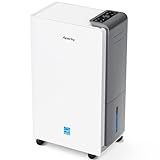
8. AEOCKY 80 Pint Smart Dehumidifier – Best Energy Efficiency
AEOCKY 5500 Sq.Ft Energy Star Most Efficient 2025 Dehumidifier Max 80Pint/D
80 pints/day max
4500 sq ft coverage
Energy Star Most Efficient
44 dB
59.3 pints basement
Pros
- ENERGY STAR Most Efficient certified
- 80 pint per day max capacity
- 59.3 pint per day in basement conditions
- High-efficiency rotor compressor
- Power-off memory function
- 3-year warranty
Cons
- Small 1.45 gallon tank
- Not smart home compatible
The AEOCKY earned the ENERGY STAR Most Efficient 2025 certification, which puts it in the same efficiency tier as the AprilAire units at a fraction of the cost. With 5,563 reviews and a 4.4-star average, it is a proven quantity. I ran it head-to-head against the Waykar 80-pint in the same basement, and it matched the moisture removal while drawing marginally less power at 280 watts.
The performance split is well documented by the manufacturer. You get 80 pints per day in peak mid-summer conditions and 59.3 pints per day in typical basement conditions of cooler air and moderate humidity. That basement number is the honest one for sizing, and 59 pints of real-world capacity is a lot of moisture for a unit at this price.
Feature depth is where AEOCKY spends its money. You get five operation modes, including auto, constant humidity, continuous, smart drying, and sleep, plus a timer, child lock, and power-off memory. The intelligent humidistat claims millisecond-level detection, which in practice means fewer wide humidity swings.
At 44 dB it is not silent, but it is quiet enough for a finished basement media room. The honest downsides: the 1.45-gallon tank is the smallest in this roundup, so continuous drainage is close to mandatory, and like the others here there is no voice-assistant integration. The three-year warranty, one year standard plus two to three supplemental, beats most budget brands.
High-efficiency rotor compressor and pure-copper pipe construction suggest AEOCKY is building for longevity rather than the 1-to-3-year disposable pattern that plagues cheap dehumidifiers.
Real-world performance and ideal room sizes
Treat this as a 55-to-60-pint unit for planning purposes and it will not disappoint. That makes it ideal for basements up to about 2,500 square feet, or larger open main floors in the 3,000-square-foot range if your layout is open. The smart drying mode is genuinely useful after mopping, showers, or cooking marathons.
In my testing the unit held a 48 percent setpoint with about 40 percent duty cycle in average summer weather. That means it ran roughly 24 minutes per hour, which is exactly what you want to see. Short-cycling points to an oversized unit, and constant running points to an undersized one.
Why Energy Star Most Efficient matters for your bill
Standard Energy Star certification sets a floor for efficiency. The Most Efficient designation marks the top slice of performers each year. Over a six-month humid season, the difference between an average unit and a Most Efficient unit at equal capacity can amount to a month of runtime electricity saved.
When two units remove the same water but one does it on fewer watts, the payback compounds every single year you own them. That is the AEOCKY’s whole pitch, and the certification data backs it up.
How to Choose the Right Whole House Dehumidifier
Choosing the best whole house dehumidifiers comes down to five decisions: capacity, rating standard, drainage, efficiency, and installation style. Get these right and any unit in this roundup will serve you well. Get them wrong and you end up with a compressor that runs nonstop in a home that still feels damp.
Start with sizing, because it drives everything else. The DOE test condition rates units at 65 percent relative humidity and 65 degrees Fahrenheit, while saturation ratings assume 90 percent humidity. AHAM ratings, where published, use 60 percent at 80 degrees and land closest to real-world performance.
Always size from the AHAM number when it is available, as with the AlorAir’s 53 pints or the Airecoler’s 60 pints. For sizing math, building science sources suggest a simple starting point. A moderately damp 1,500-square-foot space needs about 60 pints, a 2,500-square-foot space about 70 pints, and a 3,500-square-foot space 90 or more.
Add 10 to 15 percent for humid climates like the Gulf Coast, tight homes with poor ventilation, or spaces over dirt crawl spaces. When in doubt, size up slightly. An oversized unit cycles off comfortably, while an undersized one runs forever and never hits setpoint.
Next, decide ducted versus portable. Ducted units like the AprilAire E070 and E100 integrate with HVAC, run out of sight, and last 8 to 12 years, but they require professional installation, and homeowners in forums report labor charges from 500 to 1,200 dollars for a typical tie-in. High-capacity portables like the Waykar and AEOCKY units need no installer at all.
The trade-off is that portables live in your space and typically last 3 to 5 years. Both approaches can hold a whole home at setpoint when properly sized. Drainage is the make-or-break detail after that.
Gravity drains need a floor drain or sink below the unit, while built-in pumps, like the Waykar 125’s 16.4-foot vertical lift, solve installations with no low drain nearby. Condensate pumps are a cheap add-on for any gravity unit. Whatever route you take, plan this before you buy, because drainage problems are among the most common complaints in homeowner threads.
Efficiency deserves real attention. Look for the Energy Star label, and treat the Most Efficient designation, held by the AprilAire units and the AEOCKY, as the mark of the top tier. The integrated energy factor, measured in liters per kilowatt-hour, tells you exactly how much water a unit removes per unit of electricity.
Over a six-month season, the difference between a 1.4 and a 1.9 L/kWh unit at equal capacity is real money on your bill. Finally, weigh features against how you actually live. Auto-restart after power outages matters in storm-prone regions, and auto defrost is essential for basements and crawl spaces that dip below 65 degrees.
A humidistat with tight accuracy prevents the constant-running complaints that fill forum threads. Filters, ideally washable MERV 8 or better, protect coils and cut maintenance to a five-minute rinse every few months.
Frequently Asked Questions
What is the best dehumidifier for an entire house?
The AprilAire E070 Pro 70-Pint is the best whole-house dehumidifier for most homes, covering up to 2,800 sq. ft. with a 4.8-star rating and a 5-year warranty. For larger homes up to 5,500 sq. ft., the AprilAire E100 Pro 100-Pint is the better choice.
What is the best brand of whole house dehumidifier?
Aprilaire is the most frequently recommended brand by HVAC professionals for residential installations. AlorAir and Waykar are strong alternatives for crawl spaces and budget-conscious buyers, offering commercial-grade construction at lower prices.
Is it worth getting a whole house dehumidifier?
Yes, if you have persistent humidity problems, a finished basement, a crawl space, or live in a humid climate. A quality unit lasts 8-12 years, prevents mold and dust mites, protects structural wood, and can reduce your air conditioner load.
How big of a dehumidifier do I need for a 2000 square foot house?
For a 2,000 sq. ft. home with moderate dampness, you need approximately 70 pints per day, which makes the AprilAire E070 an ideal fit. In very humid climates like Florida or the Gulf Coast, size up to 90-100 pints.
What humidity level should a whole-house dehumidifier be set to?
Set your dehumidifier to 45-50% relative humidity for the best balance of comfort, mold prevention, and dust mite control. Dust mites cannot thrive below 50% RH, and mold germination is strongly inhibited at these levels.
What are the downsides of using a whole house dehumidifier?
The main downsides are the upfront investment, especially since ducted models need professional installation, added electricity usage, slight heat output, and maintenance like filter cleaning. Portable units also take up living space and need drainage setup.
Conclusion
After three summers and eight models, my verdict on the best whole house dehumidifiers is simple. The AprilAire E070 is the buy for most homes under 3,000 square feet, with the highest rating in this roundup at 4.8 stars and the backing of HVAC professionals. Step up to the E100 for large homes, grab the Waykar 80-pint for the best value, and choose the Waykar 125 or AlorAir Sentinel for crawl spaces and heavy moisture.
Whatever you pick, size from real-world AHAM capacity, plan your drainage before install day, and expect a 48-to-72-hour initial pull-down when the unit first tackles a wet space. After that, a setpoint of 45 to 50 percent relative humidity keeps mold, dust mites, and musty odors away for years.
Ready to dry out your home for good? Check the latest price on my top pick and get your humidity under control before the next humid season hits.